
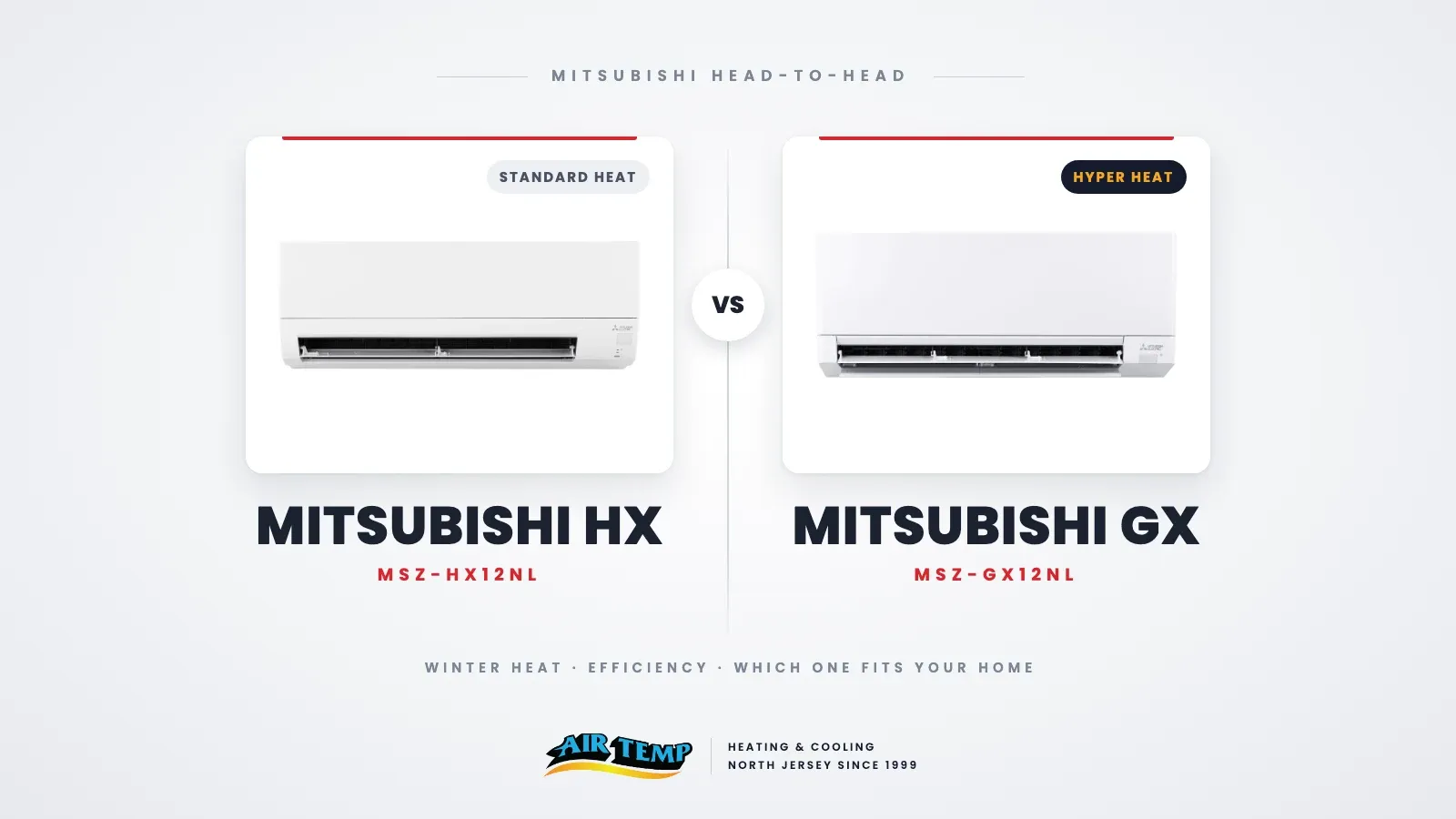
If you're weighing the Mitsubishi HX vs GX, you're probably looking at a quote for a wall-mounted mini-split and wondering whether hyper heat is worth it. Both are Mitsubishi wall-mounted heat pumps that cool in summer and heat in winter, and both come in several sizes. The difference shows up on the coldest nights of the year.
The short answer
The GX, paired with its hyper heat outdoor unit, keeps its full rated heat down to 5 degrees and keeps heating down to 22 below zero. The HX is a standard heat pump. It's efficient and ENERGY STAR certified for cold climates, but its heat output drops as the temperature falls, and it's rated to heat down to 5 below zero.
So the right pick depends on the job:
- Mostly cooling, with some heat in spring and fall: the HX handles it, and so does the WX.
- A room you want warm all winter, with a boiler or furnace behind it as backup: the GX.
- The main heat for the space, with nothing behind it: hyper heat, and our pick is the FX.
Mitsubishi HX vs GX, side by side
These are Mitsubishi's published figures for the 12,000 BTU size of each: the MSZ-HX12NL wall unit with the MUZ-HX12NL outdoor unit, and the MSZ-GX12NL wall unit with the MUZ-GX12NLHZ hyper heat outdoor unit. Heat figures are maximum output. Other sizes have their own figures, so check the ones for the size on your quote.
- Cooling: HX 12,000 BTU rated (13,400 max); GX 12,000 BTU rated (14,000 max)
- Heat at 47F: HX 15,500 BTU; GX 19,100 BTU
- Heat at 17F: HX 9,000 BTU; GX 16,000 BTU
- Heat at 5F: HX 8,600 BTU; GX 12,300 BTU
- Heat at -5F: HX 8,300 BTU; GX 9,540 BTU
- Heat at -10F: HX below its range; GX 8,160 BTU
- Heat at -22F: HX below its range; GX 4,020 BTU
- Full rated heat held down to: HX no such rating; GX 5F
- Lowest heating temperature: HX -5F; GX -22F
- SEER2 (seasonal cooling efficiency): HX 20; GX 25.6
- EER2 (cooling efficiency on the hottest days): HX 12.5; GX 13.35
- HSPF2 (seasonal heating efficiency): HX 10.0; GX 10.0
- Base pan heater: HX optional add-on; GX built in
- ENERGY STAR: both certified, and both certified for cold climates
- Refrigerant: R-454B on both
Start with the 17 degree row. Nights that cold are a regular part of a North Jersey winter, and that's where the two numbers are furthest apart. The GX makes 16,000 BTU there, more than its 12,300 BTU rating at 47 degrees, while the HX makes 9,000. At 5 degrees, the HX still puts out about 70 percent of its 12,200 BTU rating at 47 degrees, while the GX puts out all of its 12,300.
Two rows are worth a second look. The HX matches the GX on HSPF2, so for the heat it does make, it's rated just as efficient over a season. And at 5 below zero, the GX makes only about 15 percent more heat than the HX. But 5 below is the bottom of the HX's range, while the GX keeps heating down to 22 below. On cooling, the GX is the more efficient of the two, at 25.6 SEER2 against the HX's 20.
What a North Jersey winter asks of a heat pump
Here in Little Falls, the long-term weather averages show about 41 nights a year at 20 degrees or colder, and about 8 or 9 nights at 10 degrees or colder. A night at zero or colder comes along less than once a year on average. Towns to the west and northwest see more cold nights. Boonton, in Morris County, averages about 12 nights a year at 10 or colder.
So the HX's 5 below limit rarely comes into play here. What matters more is how much heat each unit makes on those 20 and 10 degree nights, because a room loses heat fastest when it's coldest outside. On a 17 degree night, the GX can put out close to 80 percent more heat than the HX. In a room that needs more than the HX can give, that's the difference between staying warm and falling behind.
Choose by the job the unit has to do
Mostly cooling, with some heat in spring and fall
This is the bedroom or office that already has baseboard or radiators, where the mini-split is mainly for summer and for chilly mornings in April and October. Hyper heat doesn't add much here. The HX covers this job well, and it cools more efficiently than the WX, our value-line choice for the same job.
A room you want warm all winter, with other heat behind it
Say the room has heat, but it's the cold one, over the garage or at the far end of the house. You want the heat pump carrying the room most of the winter and the old system as the backup. The HX can do part of this, but on the coldest nights it'll lean on that backup more. The GX is the better fit, because it holds full output down to 5 degrees and keeps heating far below that. If it's the hardest room in the house to keep warm, look at the FX.
The main heat for the space
If the heat pump will be the only heat in the space, like a new addition or a finished basement, this is where hyper heat pays off. The FX is the tier we point people to here, since it holds its full output down to 10 below, while the HX's range ends at 5 below.
Whichever unit you choose, it has to be sized to the room's actual heat loss with a load calculation, not picked by the number on the box.
Where the WX and FX fit
Two more Mitsubishi wall-mounted tiers often come up next to these. The WX is the value line. It's rated to keep heating down to 5 degrees, but Mitsubishi doesn't publish how much heat it makes there, and its HSPF2 of 8.5 is below the HX's 10.0. It's a cooling-first choice. The FX is the flagship hyper heat tier. In the 12,000 BTU size it makes 16,200 BTU at 5 degrees and holds its full rated heat down to 10 below.
Our Mitsubishi hyper heat guide compares the WX, GX and FX spec by spec.
How to spot hyper heat on a quote
Hyper heat lives in the outdoor unit, and the GX wall unit can pair with more than one. The hyper heat GX outdoor unit has HZ in its model number, like the MUZ-GX12NLHZ. A GX outdoor unit without the HZ is a standard heat pump. So if a quote says GX, check the outdoor model number.
If a quote names the HX, it's a standard heat pump by design, and that's fine for the right room. On the MUZ-HX12NL, the base pan heater is an optional add-on, so ask whether it's included.
Rebates and warranty
On paper, the HX and GX both clear the efficiency minimums for PSE&G's and JCP&L's heat pump rebates, including PSE&G's cold climate tier, which asks for a COP of at least 1.75 at 5 degrees, meaning 1.75 units of heat for each unit of electricity. Both list 1.8. The WX's EER2 of 9.0 falls short of those programs' minimums. PSE&G's larger building decarbonization rebates also require the heat pumps to be sized to cover the home's full calculated heating load, and a unit that holds its output in the cold can make that easier to reach. Program rules change, so we check the current requirements for your exact model and home when we quote.
Mitsubishi's warranty works the same way on both. In an owner-occupied home, a system registered within 90 days gets 10 years on parts and the compressor. When a Diamond Contractor installs it and registers it within 90 days, that becomes 12. Either way, the extended coverage holds only while the original buyer lives in the home. We're a Mitsubishi Diamond Elite contractor.
Frequently Asked Questions
Is the Mitsubishi HX a hyper heat unit?
No. The HX is a standard Mitsubishi heat pump. It's ENERGY STAR certified for cold climates and rated to heat down to 5 below zero, but its output falls as it gets colder: at most 9,000 BTU at 17 degrees and 8,600 at 5 degrees for the 12,000 BTU model. The hyper heat GX holds its full rated heat at 5 degrees.
What's the difference between Mitsubishi hyper heat and a regular heat pump?
A regular heat pump loses heat output as the outdoor temperature drops, and it stops at the bottom of its range. The hyper heat GX holds its full rated output down to 5 degrees, and the FX holds it down to 10 below. Both keep heating down to 22 below and have a built-in base pan heater to keep the outdoor unit clear in freezing weather.
Mitsubishi HX vs WX: which is better for heat?
The HX. Both are standard heat pumps, but the HX has an HSPF2 of 10.0 against the WX's 8.5, publishes its heat output down to 5 below zero and is ENERGY STAR certified. The WX is rated to heat down to 5 degrees, but Mitsubishi doesn't publish its output there. For a room that mostly needs cooling, the WX is still a sensible value choice. If heat is the main reason you're buying, look at the hyper heat GX or FX instead.
Do I need hyper heat in North Jersey?
You need it when the heat pump has to carry a room through the coldest nights. If the unit is the main heat, or the room has to stay warm all winter, hyper heat is worth it: the GX for a room with other heat behind it, and the FX when nothing else heats the space. If the unit mostly cools and takes the edge off in spring and fall, a standard heat pump does the job.
Get the right Mitsubishi for the room
The Mitsubishi HX vs GX choice comes down to one question: what does the unit have to do on a 10 degree night? Answer that, and the right tier is usually clear. We'll do the load calculation for your room and tell you which unit fits.
Air Temp Service Co has served North Jersey homeowners since 1999, family-owned by Mario and Lori Riccobono. Both NJ licenses are on file (HIC 13VH00127600 and Master HVACR 19HC00254600), and we hold Mitsubishi Diamond Elite and Trane Premier Contractor credentials. We install ductless heat pumps across Passaic, Bergen, Essex, and Morris counties, with upfront pricing.
Call (973) 754-1232 for a free estimate, or to ask which Mitsubishi tier fits your room.