
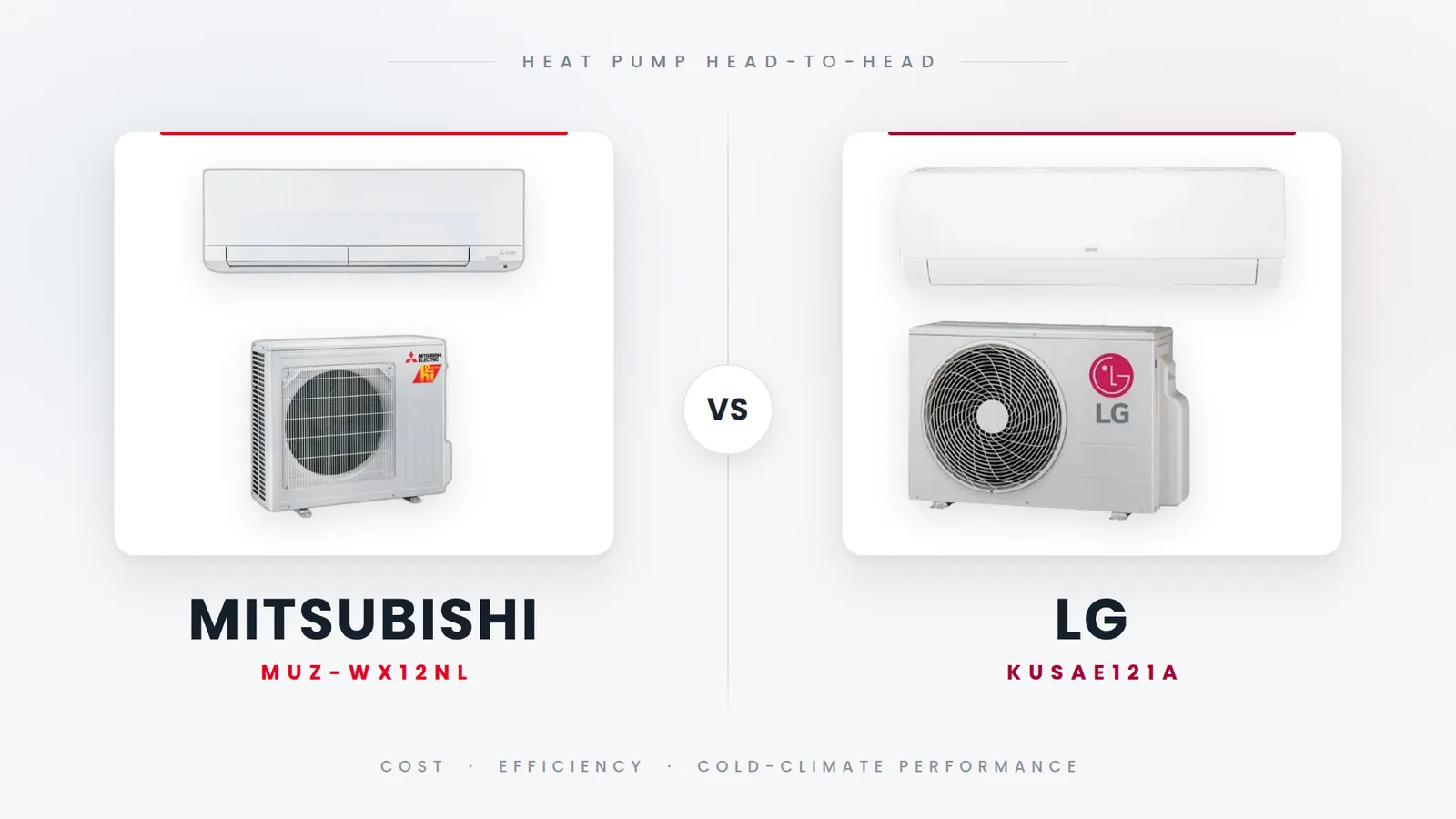
You have two quotes on the kitchen counter. One is for the system we install: the Mitsubishi MUZ-WX12NL outdoor unit paired with the MSZ-WX12NL wall unit. The other is from a shop that carries LG, quoting the KUSAE121A outdoor unit with the KNSAE121A head from LG's value line. Both are 12,000 BTU class wall-mounted mini-splits, both heat as well as cool, and both run on a standard 208/230V circuit. So in the Mitsubishi MUZ-WX12NL vs. LG KUSAE121A decision, what actually separates them? We pulled both manufacturers' published engineering data, and here is the honest breakdown for a North Jersey home.
The quick verdict
On the headline efficiency numbers, this is a dead heat: both systems post 18.0 SEER2 and 8.5 HSPF2. Where the Mitsubishi pulls ahead is in the numbers that decide whether a 12,000 BTU unit actually does its job: a true 12,000 BTU cooling rating against the LG's 11,000, more heating output at the temperatures where a New Jersey winter spends most of its time, and a warranty path through Diamond Elite contractors that reaches 12 years against the LG's 10. The LG earns two real wins, a stronger EER2 rating and better output retention in the coldest snaps, and we will not pretend otherwise. On balance, the Mitsubishi takes this comparison, and the sections below show exactly why.
The spec table, from the engineering data
Rated cooling: Mitsubishi 12,000 BTU (max 12,200); LG 11,000 BTU (max 13,780)
Rated heating at 47F: Mitsubishi 12,200 BTU (max 14,500); LG 12,000 BTU (max 13,780)
Heating at 17F: Mitsubishi 7,500 rated, 9,000 max; LG 8,000 rated, 10,560 max
Max heating at 5F: Mitsubishi 6,780 BTU; LG 8,400 BTU
SEER2: Mitsubishi 18.0; LG 18.0
EER2: Mitsubishi 9.0; LG 12.0
HSPF2: Mitsubishi 8.5; LG 8.5
Refrigerant: Mitsubishi R-454B; LG R-32
Power: Mitsubishi 208/230V; LG 208/230V
Outdoor sound level: Mitsubishi 51 dB(A); LG 50 dB(A)
Compressor: Mitsubishi Inverter rotary; LG Inverter, variable speed
Parts warranty: Mitsubishi 10 yr registered, 12 yr via Diamond contractor; LG 10 yr registered within 60 days
Specs verified against manufacturer product data, August 2026.
Every figure comes from the manufacturers' own published submittal and engineering data, not from marketing pages. One quick read on the sound row: at 51 and 50 decibels outdoors, these two are effectively tied, and placement matters more than the rating. Now what the rest of those numbers mean on your wall.
Capacity: what "12,000 BTU class" actually means
Here is the number most buyers never notice. The LG is sold in the 12,000 BTU class, but its published rated cooling capacity is 11,000 BTU. The 12,000 figure on the LG is its heating rating. The Mitsubishi is rated at a full 12,000 BTU of cooling.
Is 1,000 BTU a dealbreaker? In a properly sized room, usually not, and the LG can surge to 13,780 when conditions demand it. But the rated number is the one a system delivers hour after hour on a 95 degree North Jersey afternoon, and if your room sits at the top of the range for a 12,000 BTU unit, with big windows, western sun, or a kitchen next door, the Mitsubishi simply rates higher where it counts. This is exactly why reading the submittal sheet beats reading the product title, and why sizing should come from a load calculation rather than a class label.
Efficiency: a tie, with one asterisk
Rating for rating, these two are as close as it gets. Both post 18.0 SEER2, the seasonal cooling efficiency number that drives your summer PSE&G or JCP&L bill, and both post 8.5 HSPF2 on the heating side. Over a decade of North Jersey seasons, the operating cost difference between them on those two figures rounds to nothing.
The asterisk is EER2, the efficiency rating at a fixed 95 degree test point, where the LG posts 12.0 against the Mitsubishi's 9.0. That is a real gap on the hottest afternoons of the year, and it is the LG's strongest paper advantage. It is worth weighing against the capacity story above, since an efficient 11,000 BTU rating and a slightly less efficient 12,000 BTU rating land closer together in a real room than the spec sheet suggests. And the caveat we repeat every time still holds: a well-installed system routinely outperforms a carelessly installed one with better numbers.
Heating a North Jersey winter: two different strengths
Both systems are heat pumps, and both keep working into single digits. What separates them is where each one is strongest.
At the 47 degree rating point, which is where a typical North Jersey winter day lives, the Mitsubishi is rated at 12,200 BTU with a maximum of 14,500, against the LG's 12,000 rated and 13,780 maximum. On the ordinary cold days that make up most of the season, the Mitsubishi has more headroom.
In the deep cold, the LG holds more of its output: 8,000 rated and 10,560 maximum at 17 degrees against the Mitsubishi's 7,500 and 9,000, and 8,400 maximum at 5 degrees against 6,780. That is a fair win for the LG, and if the room you are heating is one you need warm on the handful of single-digit mornings each winter, it matters.
The line we say in every one of these comparisons: both are value lines, not cold-climate flagships. Neither should be the only heat source for a space without a backup plan. For a bedroom, an office, or an addition with central heat behind it, both are capable heating companions, and the Mitsubishi's edge on the common days generally outweighs the LG's edge on the rare ones.
Power and refrigerant: even ground
Unlike some competitors we have compared, the LG KUSAE121A runs on the same 208/230V circuit the Mitsubishi requires, so neither system offers an electrical shortcut and the panel conversation is identical either way. The LG does ship with built-in Wi-Fi control, where the Mitsubishi uses an added interface for app control, a small convenience worth knowing about.
On refrigerant, the Mitsubishi runs R-454B and the LG runs R-32. Both are the new generation that replaced R-410A, both carry a far lower environmental impact, and both sidestep the R-410A price squeeze driving up repair costs on older systems. Whichever you choose, you are on the right side of the refrigerant transition.
Warranty: the Diamond difference
Both brands land at 10 years of registered parts coverage on paper, with LG requiring installation by a licensed contractor and registration within 60 days. The separation happens at the installer level. When a Mitsubishi system is installed in a single-family home by a Diamond contractor and registered within 90 days, parts and compressor coverage extends to 12 years. Air Temp is a Mitsubishi Diamond Elite contractor and handles that registration for you, so the Mitsubishi path through our shop carries two extra years of coverage the LG cannot match.
Beyond the years, the practical question is service depth. Mitsubishi's contractor network in North Jersey is deep, parts availability is strong, and a warranty is only as useful as the speed of the repair behind it in February.
Price, rebates, and the real number
At Air Temp, a single-zone ductless installation runs $8,900 upfront, installed, with no surprise change orders. Both of these systems sit in their brands' value tiers, so neither carries a flagship premium, and the meaningful differences between two quotes usually come from the electrical scope, line set routing, and mounting specifics of your home rather than the equipment itself.
On rebates, the honest answer is that eligibility depends on the specific model, its efficiency tier, and each program's current qualified product list, and value-line units do not always reach the top tiers reserved for cold-climate certified equipment. New Jersey's Whole Home Energy Solutions Program pays from $2,000 up to $7,500 based on whole-project energy savings, and PSE&G and JCP&L add equipment rebates with their own rules. We verify exactly what your system and home qualify for as part of the quote, so the rebate math is real before you sign anything.
Frequently Asked Questions
Is Mitsubishi or LG better for a mini-split?
At the 12,000 BTU class value tier, the engineering data favors the Mitsubishi MUZ-WX12NL on balance. Both post 18.0 SEER2 and 8.5 HSPF2, so headline efficiency is a tie. The Mitsubishi rates a true 12,000 BTU of cooling against the LG KUSAE121A's 11,000, delivers more heating at the 47 degree point, and extends to a 12-year warranty through Diamond contractors. The LG posts a higher EER2 at 12.0 and holds more output in deep cold. Installation quality still decides real-world results.
Why does the LG 12,000 BTU mini-split only cool 11,000 BTU?
Because the class label and the rated capacity are different things. LG's published engineering data rates the KUSAE121A pairing at 11,000 BTU of cooling and 12,000 BTU of heating, with the ability to surge to 13,780 in either mode. The 12,000 BTU class name follows the heating figure. It is common across the industry for rated capacity to differ from the class label, which is why sizing should come from a Manual J load calculation and the submittal sheet, not the product title.
How much does the Mitsubishi MUZ-WX12NL heat in cold weather?
Per Mitsubishi's submittal data, the MUZ-WX12NL is rated at 12,200 BTU of heating at 47 degrees with a maximum of 14,500, delivers a rated 7,500 BTU at 17 degrees with a maximum of 9,000, and still produces up to 6,780 BTU at 5 degrees. That is solid performance for a value-line unit and enough to keep a properly sized room comfortable through a typical North Jersey winter, though it is not a cold-climate flagship designed to hold full output in single digits.
Do these mini-splits qualify for NJ rebates?
It depends on the specific model, its efficiency tier, and each program's current qualified product list, so verify at quote time rather than assume. New Jersey's Whole Home Energy Solutions Program pays from $2,000 up to $7,500 based on whole-project energy savings, and utility programs like PSE&G and JCP&L add equipment rebates with their own eligibility rules, with the richest tiers generally reserved for cold-climate certified models. Air Temp confirms eligibility and handles the paperwork as part of every quote.
Get a Real Recommendation for Your Room
A spec table is a starting point, not an answer. Between these two, the Mitsubishi earns the edge on rated capacity, everyday heating output, and warranty depth, while the LG earns credit for its EER2 and cold-snap retention. The right call for your home comes down to the room's actual load, its exposure, and the installer standing behind the work for the next decade.
Air Temp Service Co has served North Jersey homeowners since 1999, family-owned by Mario and Lori Riccobono. Both NJ licenses are on file (HIC 13VH00127600 and Master HVACR 19HC00254600), and we hold Mitsubishi Diamond Elite and Trane Premier Contractor credentials. We install and service Mitsubishi ductless systems across Passaic, Bergen, Essex, and Morris counties, with upfront pricing and rebate paperwork handled for you.
To find out which system fits your home, call Air Temp at (973) 754-1232 or schedule online at airtempserviceco.com.