
Many North Jersey houses have one room that never warms up. It might be the bonus room over the garage, a sunroom, a finished basement or the bedroom at the far end of the duct run. The rest of the house is comfortable, and that one room stays cold enough that someone drags in a plug-in heater every October. If you are weighing a space heater vs mini split for that room, the right choice comes down to how much heat the room needs and how often you use it.
Below are the numbers, using New Jersey electric rates and manufacturer ratings.
First, find out why the room is cold
Before buying anything, it's worth knowing the cause. A room over an unheated garage or a sunroom full of glass loses heat faster than the rest of the house. A room added after the house was built often sits at the end of a duct run that was never sized for it, or has no supply duct at all.
Some causes are cheap to fix. Check that the supply register is open and not blocked by furniture or a rug, and check the furnace filter. A clogged filter cuts airflow, and the farthest rooms usually feel it first. If the room is still cold after that, the existing system probably cannot reach it, and you need a dedicated heat source.
What a space heater really costs to run
Plug-in space heaters typically top out at 1,500 watts on their high setting.
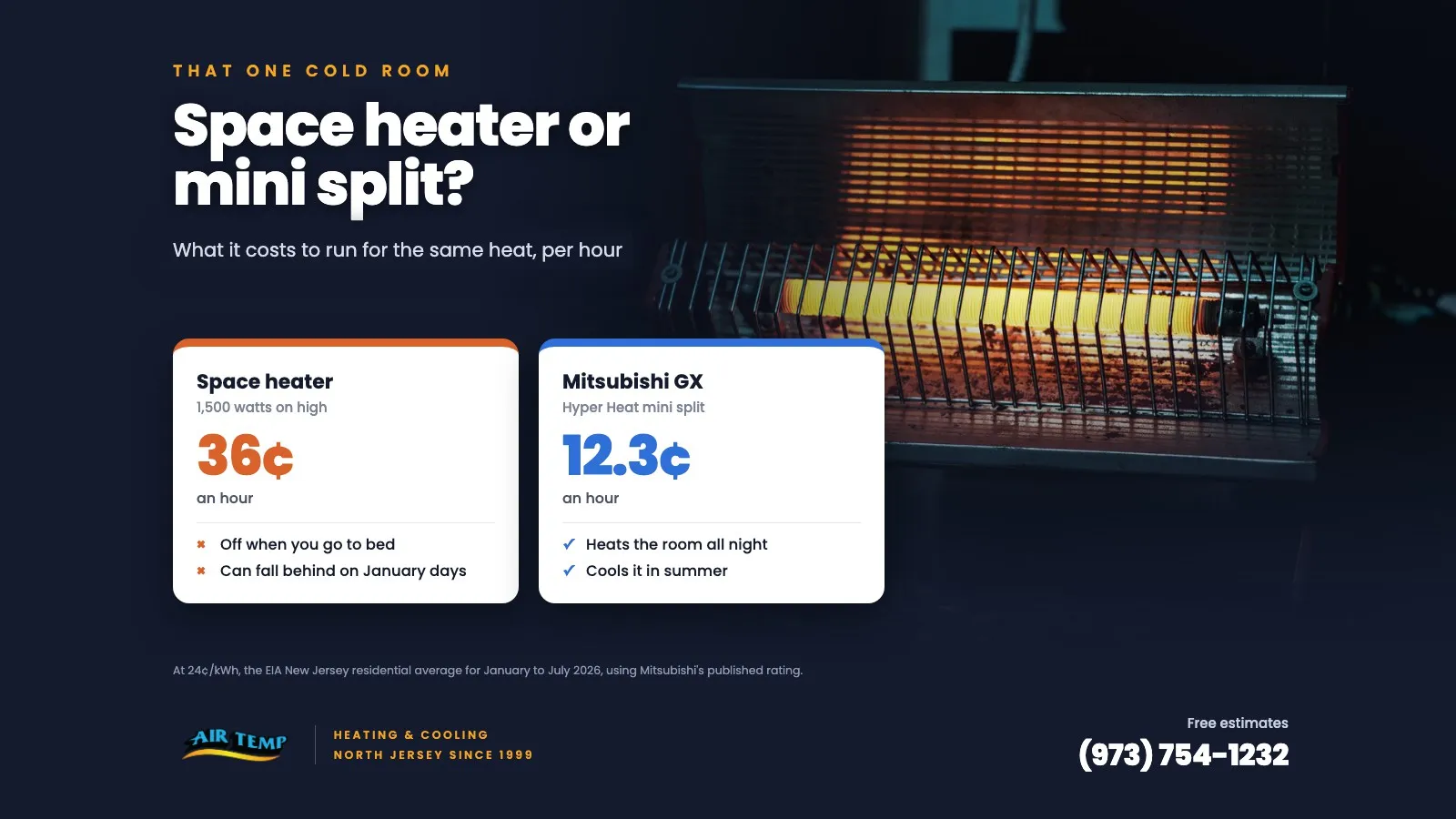
The U.S. Energy Information Administration puts the average New Jersey residential electric rate at 23.98 cents per kilowatt-hour for January through July 2026. At 24 cents, a 1,500 watt heater costs about 36 cents for every hour it runs on high, and about 18 cents on a 750 watt low setting, if yours has one.
That sounds small until you add it up. Suppose the heater runs eight hours a day through a five-month heating season of roughly 150 days. On high, that comes to about $432 in electricity for one room.
A space heater also has a hard capacity limit. Every watt of electricity turns into exactly one watt of heat, so a 1,500 watt heater delivers about 5,100 BTU per hour and no more. In a room with lots of glass or a cold floor, that may not be enough to keep up on a January day.
The safety side of space heaters
The National Fire Protection Association lists heating equipment as one of the leading causes of home fire deaths. Its guidance for portable heaters is direct: keep anything that can burn, and children, at least three feet away, and turn portable heaters off when you leave the room or go to bed.
Following that rule means a space heater cannot keep a bedroom warm overnight, which is often the exact job you bought it for. The NFPA also notes that half of home heating fires are reported during December, January and February, the months when that cold room needs the most help.
What a mini split costs to run for the same heat
A ductless mini split does not turn electricity into heat directly. It moves heat from the outdoor air into the room, so each kilowatt-hour delivers about 2.5 to 3.6 times as much heat as a space heater, depending on the model. Manufacturers publish this as HSPF2, the seasonal heating rating.
Using each model's published HSPF2 and the same 24 cent rate, here is what it costs per hour to match a 1,500 watt space heater on high:
· Mitsubishi WX-Series (MUZ-WX12NL), 8.5 HSPF2: about 14.5 cents per hour.
· Mitsubishi GX Hyper Heat (MUZ-GX12NLHZ), 10.0 HSPF2: about 12.3 cents per hour.
· Mitsubishi FX Hyper Heat (MUZ-FX12NLHZ), 12.4 HSPF2: about 9.9 cents per hour.
Specs verified against manufacturer product data, October 2026. Costs calculated at 24 cents per kWh.
In the same eight-hours-a-day example, the GX would use about $147 in electricity against the space heater's $432. HSPF2 is a seasonal average, so the cost runs higher on the coldest days and lower on mild ones. Over a full season, the GX uses roughly a third of the electricity for the same heat.
Capacity is the bigger difference. According to Mitsubishi's submittal, the GX can deliver up to 12,300 BTU of heating at 5°F, equal to its rated capacity and more than twice what a space heater can produce. The value-tier WX is rated to keep heating down to 5°F, but Mitsubishi does not publish how much heat it delivers at that temperature. Efficiency holds up in the cold too: running flat out at 5°F, the GX's submittal lists a coefficient of performance of 1.80, so it still delivers 80 percent more heat per kilowatt-hour than a plug-in space heater. A mini split is also built to run around the clock on its own thermostat, so a bedroom can stay warm all night. In summer, the same unit cools the room, which matters for the bonus room over the garage.
Is a mini split worth it over a space heater?
A space heater costs very little to buy. A mini split is a permanent installation, priced by tier, and we quote it after seeing the room. PSE&G's instant rebates for qualifying heat pumps run $300 to $600 by efficiency tier, and JCP&L lists a $750 rebate for qualifying ductless mini-split heat pumps (verified October 2026). Not every model qualifies. JCP&L's ductless rebate requires at least 17.1 SEER2, 11.7 EER2 and 7.8 HSPF2. The GX and FX ratings clear all three, and the WX's 9.0 EER2 misses the minimums at both utilities. The larger NJ Whole Home Energy Solutions rebates are tied to projects that reach at least 5 percent total energy savings, so a single room may not qualify on its own. We check that during the estimate.
On electricity savings alone, the payback against a space heater runs to decades. In our example the savings come to about $285 a year. If you use the room a few evenings a month, a space heater used carefully is the sensible, inexpensive answer, and we will tell you so.
A mini split earns its price when the room is used every day and needs heat through the night. Summer cooling strengthens the case. Either way, you are buying a permanent heating and cooling system for the room, not a cheaper way to run a heater.
For a room that needs real winter heat, we recommend the GX tier. The WX is a strong choice when cooling is the main job and the room only needs help in fall and spring.
Frequently Asked Questions
Is it cheaper to run a space heater or a mini split?
A mini split is much cheaper to run for the same heat. At 24 cents per kilowatt-hour, a 1,500 watt space heater costs about 36 cents an hour on high, while a Mitsubishi GX delivers the same heat for about 12.3 cents an hour on average over the heating season. The space heater costs far less to buy.
How much does it cost to run a space heater in New Jersey?
About 36 cents an hour on a 1,500 watt high setting and about 18 cents on a 750 watt low setting, at roughly 24 cents per kilowatt-hour, close to the EIA's January through July 2026 New Jersey residential average. Running one eight hours a day for 150 days comes to about $432.
Can a mini split heat a room in the middle of winter?
A Hyper Heat model can. The Mitsubishi GX can deliver its full rated 12,300 BTU of heat at 5°F, and the FX its full rated output at minus 10°F. Value-tier models lose more output as temperatures drop.
Is it safe to leave a space heater on overnight?
No. The National Fire Protection Association advises turning portable heaters off when you leave the room or go to bed. If a room needs heat through the night, it needs a permanent heat source.
Warm Up the Room That Never Warms Up
The space heater vs mini split decision comes down to how you use the room. For occasional use, a carefully placed space heater is fine. For a room you use every day, a GX ductless mini split costs about a third as much to run and keeps working through the night.
Air Temp Service Co has served North Jersey homeowners since 1999, family-owned by Mario and Lori Riccobono. Both NJ licenses are on file (HIC 13VH00127600 and Master HVACR 19HC00254600), and we hold Mitsubishi Diamond Elite and Trane Premier Contractor credentials. We install ductless systems across Passaic, Bergen, Essex, and Morris counties, with upfront pricing and rebate paperwork handled for you.
Call (973) 754-1232 to have us look at your cold room. We will find out why it runs cold and recommend the simplest fix that works. Estimates for new ductless systems are free.