
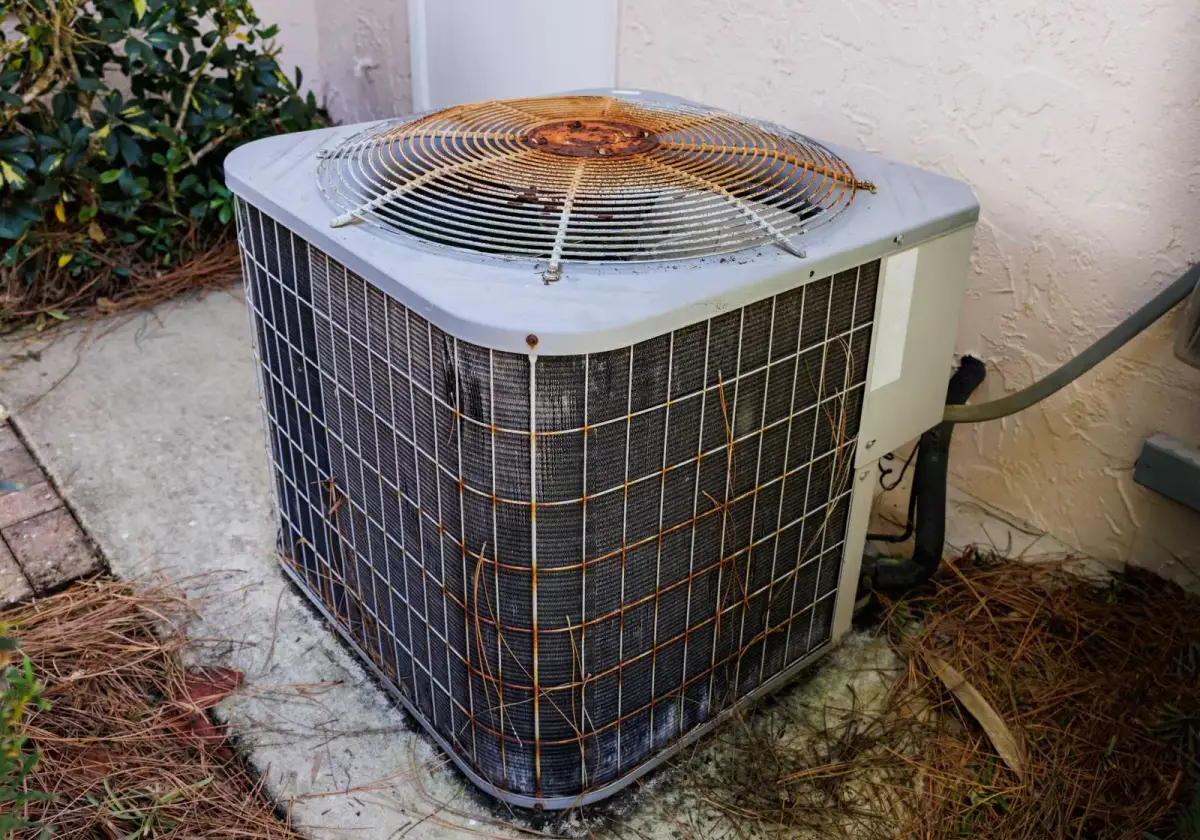
It's a Saturday afternoon in late July. The thermostat is set to 72. It's been set to 72 since 10 a.m. The outdoor unit has been running, more or less continuously, for the last six hours. And the actual temperature in the house? 78 and climbing.
You walk down to the basement to check the breaker. You change the filter even though you changed it last month. You stand in front of a register and feel air that's cool, but not the cold it used to be. By 5 p.m. it's 80 inside and you're starting to do the math on whether this is the year you finally replace the system.
Signs you need a new air conditioner show up gradually most of the time. The system doesn't die in one dramatic moment. It quietly stops doing its job, your bills creep up, and one day you realize you've been running a 15-year-old unit twice as hard for half the result.
Here are the seven signs every North Jersey homeowner should know, ranked by how urgent each one really is.
Sign #1: The System Can't Keep Up in a Heat Wave
This is the most obvious sign, but it's also the one homeowners rationalize the longest.
If your AC is running constantly but the house won't hit the set temperature on a 90-degree day, the system is past its useful life. A healthy AC, properly sized, should be able to hold your home within a few degrees of the set temperature even on the hottest day of summer. Industry standard is roughly a 15 to 20 degree differential between indoor and outdoor temperatures, narrowing somewhat in extreme heat. If yours can't do that anymore, you're not dealing with a maintenance issue. You're dealing with a system that's lost capacity.
Common in older North Jersey homes: the second-floor bedrooms in Caldwell colonials and Wayne splits where the AC kind of works until July, then gives up entirely when the real heat hits.
Sign #2: The Cooling Bills Are Climbing
The U.S. Energy Information Administration reports that air conditioning accounts for 12 to 27 percent of a typical household's monthly electric bill during cooling months. When your AC starts losing efficiency, that number climbs.
What to watch for:
Bills that are 20 to 40 percent higher than the same month last year, with similar weather and usage
A sudden jump rather than a slow climb (could indicate a refrigerant leak)
Higher bills despite a clean filter and no thermostat changes
A 15-year-old single-stage AC running in 2026 is roughly half as efficient as a modern variable-speed unit with the same nominal capacity. The math on a replacement starts making sense fast once your old system loses another efficiency point or two.
Sign #3: Some Rooms Cool, Others Don't
Uneven cooling is one of the clearest signs that your system has lost the capacity it had when it was new.
If your first floor holds 72 fine but the upstairs sits at 80 all summer, your AC isn't moving enough air to overcome the heat load on the second floor. This is especially common in:
The colonials in Hawthorne and Bloomingdale with retrofitted central air
The split-levels in Wayne where the upstairs bedrooms were always marginal
The capes in Little Falls and Totowa with sloped ceilings and dormer windows
The bonus rooms over garages in Bergen County splits
Sometimes the fix is ductwork. Sometimes it's a ductless mini-split added to the problem room. But if the system is past 12 to 15 years old and you're noticing uneven cooling that wasn't there before, the underlying issue is usually capacity loss in the main unit.
Sign #4: The House Is Cool But Clammy
This is the sign most homeowners miss.
Your AC doesn't just cool your home. It also pulls humidity out of the air. A new, properly sized system holds indoor humidity between 30 and 50 percent. As an AC ages, it loses dehumidification capacity faster than it loses cooling capacity. The result: your thermostat reads 72, but the house feels sticky, the wood floors swell, and you're still uncomfortable.
Signs your AC is failing on humidity:
The thermostat hits the set temperature but you still feel clammy
Condensation on windows when the AC is running
Mold appearing in basements, bathrooms, or around registers
Wood floors that creak more than they used to
In North Jersey, where summer dew points push past 70 routinely, an AC that can't dehumidify properly is functionally broken even if it's still blowing cold air.
Sign #5: It's Making Sounds It Didn't Used to Make
A healthy AC runs at a steady, low hum. Some sounds are early warnings:
Clicking or rattling at startup (often a failing capacitor)
Grinding or screeching (worn bearings or a failing blower motor)
Banging or clanking (loose internal components or a failing compressor)
Hissing (refrigerant leak)
Short-cycling, where the system clicks on and off every few minutes
Single noises occasionally are normal. Persistent new sounds are not. If the system has started developing a "voice" over the last summer or two, that's the system telling you parts are wearing out.
Sign #6: You're on a First-Name Basis With Your HVAC Tech
If you're calling a contractor for AC repairs more than once a season, you've crossed a threshold.
The industry standard test is the $5,000 rule: multiply the age of your system by the cost of the next repair. If the result is over $5,000, replace. If it's under, repair makes sense.
A few examples:
8-year-old system with a $400 repair = $3,200. Repair.
12-year-old system with a $600 repair = $7,200. Replace.
15-year-old system needing a $1,200 compressor repair = $18,000. Replace immediately.
The rule isn't perfect, but it captures the underlying logic: every repair on an older system buys you less time before the next one, and at some point you're throwing money at a system that should already be in a scrap yard.
Compressor failures are a special case. A failed compressor on a system over 10 years old almost always means replacement. The compressor is roughly half the cost of a new outdoor unit, and replacing one component on a tired system means the rest of the parts will fail right behind it.
Sign #7: It Uses R-22 Refrigerant
This one is non-negotiable.
R-22 (sometimes called Freon) was the standard residential AC refrigerant until 2010, when production began phasing down. Manufacturing stopped completely in 2020. The only R-22 available today is recycled, and prices have skyrocketed.
If your AC was installed before 2010, it almost certainly runs R-22. When it leaks (and old systems do leak), you're looking at $150 to $300 per pound to top it off, sometimes more. A typical residential AC holds 5 to 12 pounds.
A single R-22 service call can cost $1,500 to $3,000. Two of those a summer and you've spent more than half the cost of a new system that runs current refrigerant.
If you have an R-22 system, the question isn't whether to replace. It's when, and ideally before the next big leak.
The 15-Year Age Threshold
A few hard numbers on AC lifespan:
Average residential AC lifespan: 12 to 15 years in North Jersey's climate
Well-maintained systems: Can reach 18 to 20 years, rarely longer
Heavily used or poorly maintained systems: Often fail at 10 to 12
If your system is past 15 years, the calculation isn't "should I replace." It's "should I replace before something breaks, or after." Replacing on your schedule is significantly cheaper than replacing in the middle of a heat-wave emergency when contractors are booked three weeks out.
What to Expect From a Replacement
A modern AC replacement in North Jersey typically runs $8,000 to $15,000 for a standard central system, depending on size, efficiency, and ductwork condition. A ductless mini-split system runs $5,000 to $7,000 per zone.
A real replacement should include:
A Manual J load calculation to size the new system correctly (square footage alone isn't enough) [Internal link: HVAC system sizing and consultation]
An itemized written estimate covering equipment, labor, refrigerant, line set, and permits
Town permit pulled and inspection coordinated by the contractor
All rebate paperwork processed by the installer on your behalf
If your AC is at the end of its life and your furnace is over 10 years old too, consider a heat pump instead. A heat pump replaces both your AC and furnace in a single system, cools in summer and heats in winter, runs on electricity, and qualifies for substantially more rebate money than a traditional AC replacement.
Modern heat pumps from Mitsubishi, Trane, and Carrier in the 16 to 20+ SEER2 range cut cooling costs 30 to 40 percent compared to a 15-year-old AC. Cold climate models maintain heating efficiency down to single-digit outdoor temperatures, which matters in North Jersey winters.
North Jersey homeowners can stack multiple rebates on a heat pump install in 2026:
NJ Whole Home Energy Solutions Program: Up to $7,500, based on total energy savings
PSE&G: $900 instant rebate on a qualifying heat pump
JCP&L: $500 to $1,000, depending on system tier
NJ Natural Gas: $500 to $1,000 for air source heat pumps, with the higher amount reserved for cold-climate models
Air Temp processes the rebate paperwork on the customer's behalf so the savings come off your project cost.
As a Mitsubishi Diamond Elite Contractor and Trane Premier Contractor, Air Temp installs both ducted heat pumps and ductless mini-splits across Passaic, Bergen, Essex, and Morris counties.
Frequently Asked Questions
How long should an air conditioner last?
A residential AC in North Jersey typically lasts 12 to 15 years. Well-maintained systems can stretch to 18 or 20. Heavily used or poorly maintained units often fail at 10 to 12 years. The factors that shorten lifespan: skipping annual maintenance, running with clogged filters, oversized systems that short-cycle, and high humidity stress on the outdoor unit. After 15 years, even a working system is usually costing more in electricity than a new one would.
When should I replace my AC instead of repairing it?
The standard rule is the $5,000 rule: multiply the age of your system by the cost of the next repair. If the result is over $5,000, replace. Beyond that, automatic triggers for replacement include any of the following: the system uses R-22 refrigerant, the compressor failed, the same component has been repaired twice in two years, or the system is over 15 years old. If you're hesitating on a major repair to an aging system, that hesitation is usually telling you something.
How much does a new AC cost in NJ?
A standard central AC replacement in North Jersey runs $8,000 to $15,000 in 2026, depending on system size, efficiency rating, and whether ductwork needs modifications. A ductless mini-split runs $5,000 to $7,000 per zone. A full heat pump system (which replaces both AC and furnace) runs $8,000 to $18,000 before rebates, depending on system type. After NJ utility rebates and the NJ Whole Home Energy Solutions Program, most homeowners see total out-of-pocket cost reduced by several thousand dollars.
Is it better to repair or replace an old AC?
For a system under 10 years old with a one-time repair under $500, repair. For a system over 15 years old with any significant repair (over $800), replace. The gray zone is systems 10 to 14 years old. In that range, the $5,000 rule is your best guide. The hidden math most homeowners miss: a modern variable-speed AC running at 18+ SEER2 cuts your cooling bills enough that the new system can pay for a meaningful chunk of itself over 10 years.
Stop Patching, Start Planning
If your AC is showing two or more of the seven signs above, it's not a question of whether to replace. It's a question of whether you replace it now on your terms, or in August when the system finally quits and every reputable contractor in the area is booked weeks out.
Air Temp Service Co has been replacing AC systems across Passaic, Bergen, Essex, and Morris counties since 1999, family-owned by Mario and Lori Riccobono. Both NJ licenses on file (HIC 13VH00127600 and Master HVACR 19HC00254600). Mitsubishi Diamond Elite Contractor and Trane Premier Contractor credentials, with a 5 to 10 year installation warranty stacked on top of 10 to 12 year manufacturer parts coverage.
For a free in-home assessment with a Manual J load calculation, an itemized written quote, and full handling of your NJ rebate paperwork, call Air Temp at (973) 754-1232 or schedule online at airtempserviceco.com.