
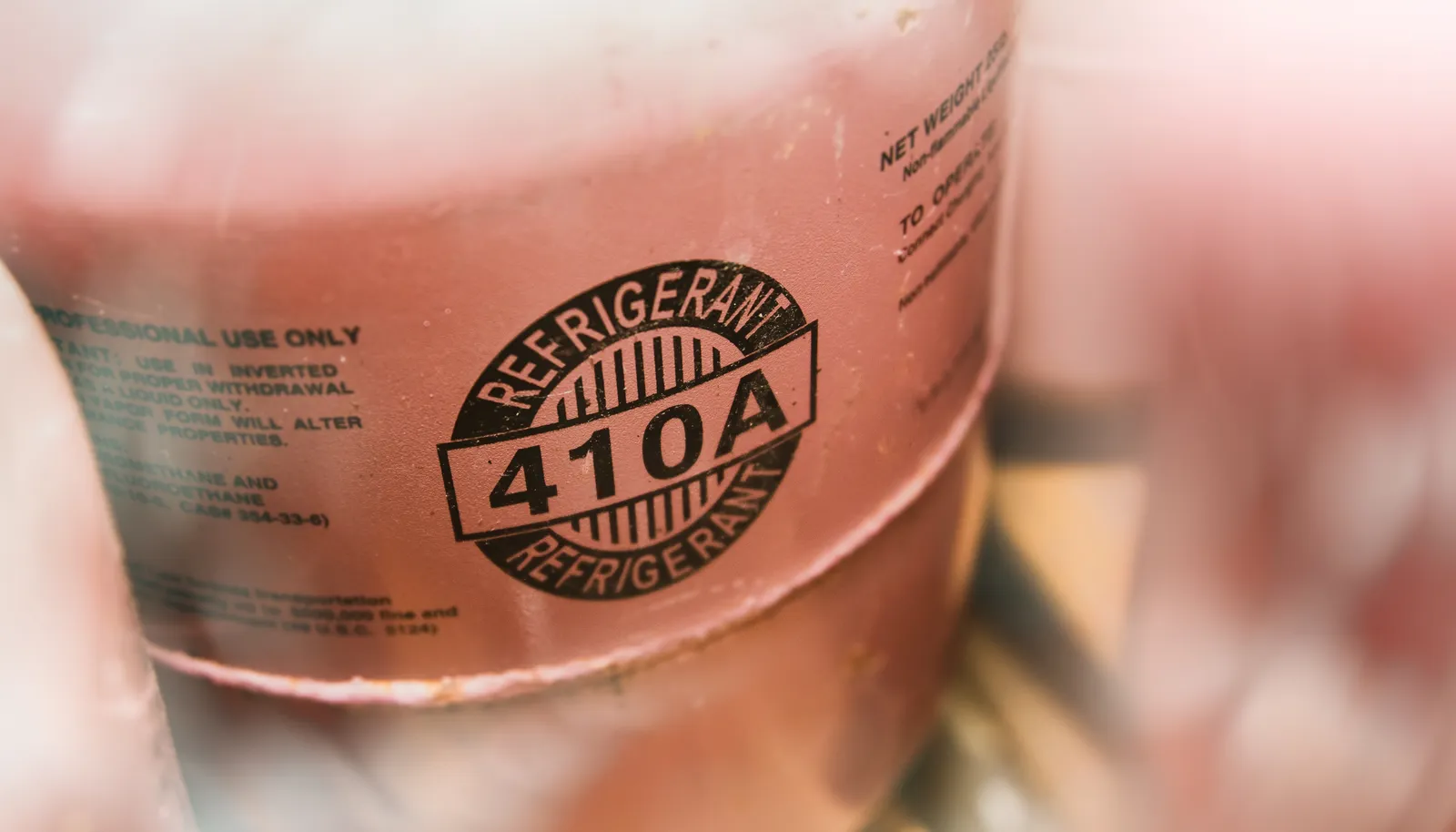
You called for a refrigerant top-off, the technician quoted a number, and you had to ask him to repeat it. If your AC repair bill this summer looks nothing like the one you paid three years ago, you are not being taken for a ride. The R-410A cost picture changed underneath the entire industry, and 2026 is the year North Jersey homeowners are feeling it on the invoice.
Here is what actually happened, what refrigerant costs now, and the point where continuing to feed an old system stops making financial sense.
Let's kill the panic first: your AC is not illegal
There is a lot of bad information circulating on this, so let's be clear. R-410A is not banned. Your system is not obsolete. You are not required to replace anything.
What changed is manufacturing. Under the EPA's AIM Act, as of January 1, 2025, new residential air conditioners and heat pumps can no longer be built or imported using R-410A. Equipment made before that date is still perfectly legal to own, run, and service. Refrigerant for servicing existing systems is still produced, still sold, and still legal to buy and install.
So if your AC is running fine, do nothing. Keep it maintained and get your money's worth out of it. The pressure here is not legal. It is financial.
What R-410A actually costs now
The AIM Act does not just cap new equipment. It steps down how much R-410A can be produced each year, on a schedule, indefinitely. Less supply, steady demand from the millions of systems still running it, and the result is exactly what you would expect.
As of mid-2026, homeowners are generally paying somewhere in the range of $40 to $90 per pound installed for R-410A, depending on the market, the contractor, and whether it is an emergency call. That number is not the raw price of the refrigerant. It bundles the technician's time, the leak check, recovery equipment, EPA certification, and the shop's overhead. Industry trackers put the increase at roughly 40 to 60 percent since the phase-down took effect in January 2025.
Now the math that matters. Most central systems hold about 2 to 4 pounds of refrigerant per ton of capacity. A typical 3-ton North Jersey home is looking at something in the neighborhood of 6 to 12 pounds for a full charge. A modest top-off often lands around $200 to $600 all in. A system that has lost most of its charge through a real leak climbs from there, and that is before anyone has repaired the leak itself.
A refrigerant line item that used to be an annoyance is now a decision point. That is the whole story of R-410A in 2026.
No, you cannot just switch your system to the new stuff
This question comes up constantly, and the answer is a clean no.
The refrigerants replacing R-410A in new equipment are R-454B and R-32. Both are A2L classified, both carry roughly a fraction of R-410A's global warming potential, and both operate at different pressures with different safety requirements. You cannot pour them into a system engineered for R-410A. The equipment is not compatible, the safety controls are not present, and no reputable technician will do it.
That is worth understanding because it shapes the real choice. Your R-410A system stays an R-410A system for its whole life. The only way onto the new refrigerants is new equipment. So the question is never whether to convert. It is how long you want to keep buying increasingly expensive refrigerant for a system that is aging anyway.
The repair-or-replace math, honestly
Here is where it gets practical. A refrigerant leak on a newer system is a repair. Find it, fix it, recharge it, move on. The economics are fine.
A refrigerant leak on a twelve to fifteen year old system is a different conversation. The system is already past the efficiency of anything you would buy today, it is already in the window where other components start failing, and now the cheapest consumable it depends on is getting more expensive every year. Coil leaks in particular are brutal, because replacing an evaporator coil on an aging system can approach a meaningful fraction of what a new system costs.
The rule most of the trade uses: if a repair costs 50 percent or more of a replacement, replacement usually wins. Refrigerant pricing has quietly pushed more repairs across that line. So has the pattern where a system needs a recharge this summer and another one next summer, which is not a repair, it is a subscription.
The honest answer depends on your system's age, where the leak is, and how many more of these bills you are willing to absorb. A technician worth hiring will lay that out and let you decide instead of defaulting to the bigger ticket.
What actually softens the cost in New Jersey
If the math points toward replacement, the incentive picture matters, and this is where a lot of the advice online is out of date.
The federal 25C tax credit expired on December 31, 2025. It is gone for 2026. If you read an article, and there are plenty still up, that tells you to claim a federal credit on a 2026 install, that article is wrong.
What is real in New Jersey right now:
The NJ Whole Home Energy Solutions Program pays from $2,000 up to $7,500, scaled by how much your whole project cuts your home's energy use. The $7,500 is the statewide maximum and the cap runs closer to $6,000 in PSE&G and NJ Natural Gas territory.
Your utility adds an equipment rebate on top. PSE&G runs instant rebates up to $900 across equipment, with heat pumps and mini-splits typically $300 to $600. JCP&L pays $500 to $1,000 tiered by efficiency. NJ Natural Gas pays $500 to $1,000 for air source heat pumps.
Zero-interest financing up to $25,000 is available through the state program.
The rebates lean toward heat pumps, which is worth knowing if you are replacing anyway. New equipment also runs on R-454B or R-32, which sidesteps the R-410A price curve entirely for the life of the system.
How to keep this from happening to you
Whether you repair or replace, a few things protect you.
Get annual maintenance. A tune-up that catches a quarter-pound leak is a different bill than the emergency call after four pounds have escaped. Ask the technician to show you why the charge is low rather than just adding more. Ask whether the quote includes finding and repairing the leak or only the top-off, because those are very different services at very different prices. And schedule non-emergency refrigerant work outside of peak summer if you can, since availability and pricing both ease up in the shoulder seasons.
Frequently Asked Questions
Is R-410A banned in 2026?
No. R-410A remains legal to own and run, and it is still legal to service and recharge an existing system. What changed is that under the EPA's AIM Act, new residential AC and heat pump equipment can no longer be manufactured or imported with R-410A as of January 1, 2025. Existing systems are unaffected and service refrigerant is still available. What is happening is a price squeeze, not a ban: annual production is stepping down on a schedule, so supply tightens and prices climb while millions of systems still depend on it.
How much does R-410A cost per pound in 2026?
Homeowners are generally paying in the range of $40 to $90 per pound installed as of mid-2026, varying by market, contractor, and whether it is an emergency call. That installed price includes the technician's labor, leak check, recovery equipment, and certification, not just the refrigerant. Most central systems hold about 2 to 4 pounds per ton, so a typical recharge often totals $200 to $600, and a system that lost a full charge through a leak runs higher.
Can I convert my R-410A system to R-454B or R-32?
No. R-454B and R-32 are A2L refrigerants that operate at different pressures and require safety controls your R-410A equipment does not have. They are not interchangeable, and no reputable technician will attempt the swap. The only path onto the newer refrigerants is new equipment. That is why the real decision with an aging R-410A system is not conversion, it is how long you want to keep buying refrigerant that gets more expensive every year.
Should I replace my R-410A system now?
Not if it is running well. Keep it maintained and use it. The calculus changes when you hit a refrigerant-involved repair on a system past roughly twelve years, especially a coil leak, or when you are recharging in consecutive summers. A common trade guideline is that when a repair reaches 50 percent of replacement cost, replacement usually wins, and rising refrigerant prices have pushed more repairs over that line. NJ rebates and the fact that new equipment uses R-454B or R-32 both improve the replacement math.
Get a Straight Answer About Your System
The refrigerant transition is real, but it is not a reason to panic or to be pressured. It is a reason to get an honest diagnosis: where the leak is, what it costs to fix, how old the system is, and what the replacement math actually looks like with rebates factored in. Those are numbers, not a sales pitch.
Air Temp Service Co has served North Jersey homeowners since 1999, family-owned by Mario and Lori Riccobono. Both NJ licenses are on file (HIC 13VH00127600 and Master HVACR 19HC00254600), and we hold Mitsubishi Diamond Elite and Trane Premier Contractor credentials. We serve Passaic, Bergen, Essex, and Morris counties, we quote upfront, and we handle your NJ rebate paperwork when replacement is the right call.
For a straight answer on a refrigerant leak or a replacement quote, call Air Temp at (973) 754-1232 or schedule online at airtempserviceco.com.