
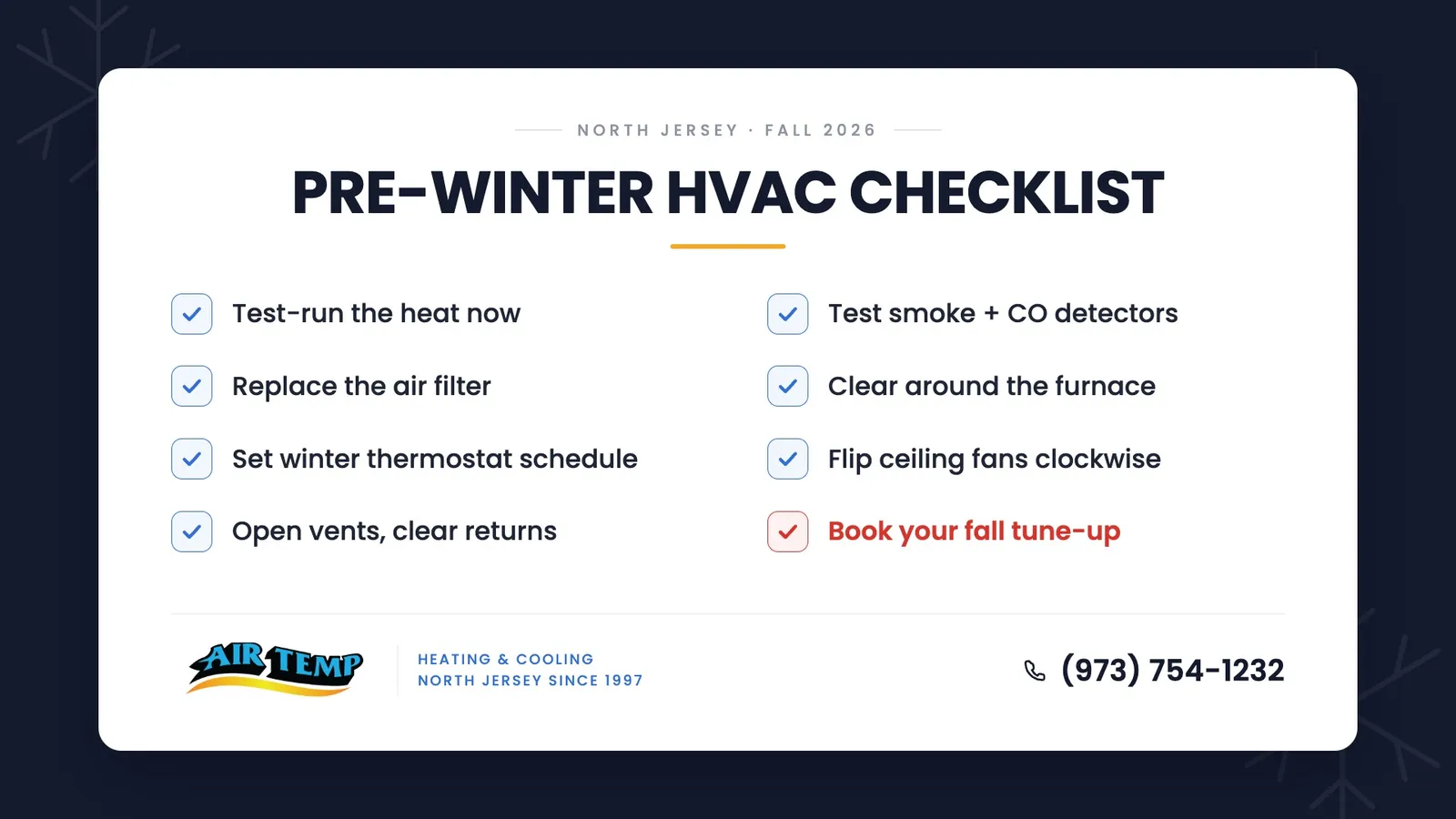
Every year it happens the same way. A warm September slides along, then one October night the temperature drops into the 30s, half of North Jersey turns on the heat for the first time, and our phone lights up with systems that will not start. Here is the thing: almost everything on that first-cold-night call list was preventable in September. So this is the pre-winter HVAC checklist we would run in our own homes, ten items, most of them free, ordered so the easy ones come first and the ones that need a professional come with enough lead time to actually book one.
The checklist
1. Turn the heat on today, before you need it
Do not let the first cold night be your system's first test. Pick a mild evening this week, switch the thermostat to heat, set it a few degrees above room temperature, and let the system run for 15 to 20 minutes. A brief burning-dust smell on the first run of the season is normal and should fade within a few minutes. What you are listening and feeling for: warm air actually arriving at the vents, the system starting without repeated attempts, and no banging, screeching, or rapid on-and-off cycling. If anything fails that test, you have weeks to fix it calmly instead of a cold house and a waitlist.
2. Replace the filter
The cheapest fix in home comfort. A summer of cooling leaves the filter loaded, and a clogged filter makes the system run longer for the same heat, strains the blower, and can trip a furnace into overheating and shutting itself down. Replace it now if you cannot see light through it, and check it monthly once the heat is running daily.
3. Check the thermostat, not just the furnace
Switch the schedule from summer to winter settings, and if the thermostat runs on batteries, change them now rather than at 2 a.m. in January when the low-battery chirp starts. If you have a programmable or smart thermostat, set the heating schedule deliberately: lower while you are away and asleep, comfortable when you are home. A schedule that runs cooler while the house is empty and asleep trims heating hours all season, so the settings you choose this month quietly shape every bill until spring.
4. Open every vent and clear the returns
Walk the house. Open supply vents in the rooms you use, make sure furniture, rugs, and curtains have not migrated over vents and return grilles during the summer, and leave most vents open even in unused rooms, since closing too many strains the blower and unbalances the system.
5. Clear the space around the furnace
Basements and utility closets collect things all summer. Keep a few feet of clear space around the furnace, and never store paint, gas cans, boxes, or anything flammable near it. The furnace needs combustion air and a technician needs working room, and clutter against a furnace is a genuine safety issue, not just an inconvenience.
6. Test the smoke and carbon monoxide detectors
If your home heats with gas or oil, working CO detectors are not optional. Test every unit, replace batteries, and check the age printed on the back, because detectors themselves expire, usually at 7 to 10 years. There should be a CO detector on every sleeping level. This is a five-minute item that outranks everything else on this list.
7. Look at the outdoor unit, and know what not to do
If you have a heat pump, clear leaves and debris from around it and keep it uncovered, because it runs all winter and needs open airflow. If you have a central AC condenser that sits idle in winter, clear the debris and skip the full plastic wrap, which traps moisture and invites rust and rodents. If you cover anything, a breathable top cover is plenty.
8. Seal the easy drafts and flip the ceiling fans
Heat you make and then leak is the most expensive kind. Check weatherstripping on exterior doors, caulk obvious gaps around window frames, and close the fireplace damper when it is not in use. Then set ceiling fans to spin clockwise on low, which pushes the warm air that pools at the ceiling back down into the room.
9. Book the furnace tune-up now, not in November
This is the one paid item on the list, and September is the right month for it. A professional tune-up at Air Temp runs $100 to $200, and it covers the things you cannot see from the thermostat: burner and heat exchanger inspection, safety controls, gas pressure, ignition, blower condition, and carbon monoxide checks. A well-maintained system runs by some estimates 15 to 25 percent more efficiently than a neglected one, and the tune-up is where a weak igniter or a cracked belt gets caught in September instead of failing in January. Fall calendars fill fast once the first cold snap hits, which is exactly why the smart booking window is now.
10. If your system is old, decide before winter decides for you
If your furnace or heat pump is past 12 to 15 years, limped through last winter, or needed repairs two seasons running, September is the month to price a replacement calmly. Fall installation means open schedules, a working system before the first freeze, and time to do the rebate math properly: New Jersey's Whole Home Energy Solutions Program pays from $2,000 up to $7,500 based on whole-project energy savings, utility programs add equipment rebates on top, and the richest tiers favor high-efficiency cold climate heat pumps. We verify exactly what your home qualifies for as part of any quote and handle the paperwork. The worst time to shop for heat is the week yours quits.
What the first cold night tells you
Run the test in item one and pay attention, because early symptoms are specific. Cold air from the vents with the system running points at ignition or airflow. Repeated short bursts of running point at overheating or a control problem. A furnace that starts, runs briefly, and locks out is protecting itself from something real. None of these improve with time, and all of them are cheaper to fix on a scheduled September visit than an emergency November one.
Frequently Asked Questions
When should I schedule a furnace tune-up in New Jersey?
September or early October, before the first sustained cold. That timing catches developing problems while parts and appointment slots are easy to get, and it means your system enters the heating season verified rather than untested. Once the first cold snap arrives, service calendars across North Jersey fill with no-heat emergencies and tune-ups get pushed back. An annual tune-up also keeps most manufacturer warranties valid, since many require documented professional maintenance.
How much does a furnace tune-up cost?
At Air Temp, a professional tune-up runs $100 to $200. That includes inspection of the burners and heat exchanger, safety and carbon monoxide checks, gas pressure and ignition testing, and a look at the blower and belts. It is the single most cost-effective service on the fall checklist, both because a maintained system runs meaningfully more efficiently and because it converts January emergency repairs into September scheduled ones.
Why does my furnace smell when I first turn it on?
A dusty, faintly burning smell on the first run of the season is normal. Dust settles on the heat exchanger and burners all summer, and it burns off in the first few minutes of operation. It should fade quickly and not return on later runs. What is not normal: a smell that persists beyond the first use, anything electrical or plastic-like, or any gas odor. Shut the system down for electrical smells, and for gas, leave the house first and call from outside.
Should I cover my air conditioner for the winter?
Not with a full wrap. Sealing a condenser in plastic traps moisture against the coils and wiring and creates an inviting winter shelter for rodents, both of which cause more damage than snow ever does. The unit is built to sit outside. Clear leaves and debris from around it, and if you want protection from falling ice or heavy debris, use a breathable top cover only. If you have a heat pump rather than an AC, never cover it at all, because it runs all winter.
Get Winter-Ready While It Is Still Easy
Nine of these ten items cost little or nothing and fit into a single weekend. The tenth is a phone call. Run the checklist now and the first cold night becomes a non-event: the heat comes on, the house warms up, and the emergency calendar belongs to someone else.
Air Temp Service Co has served North Jersey homeowners since 1999, family-owned by Mario and Lori Riccobono. Both NJ licenses are on file (HIC 13VH00127600 and Master HVACR 19HC00254600), and we hold Mitsubishi Diamond Elite and Trane Premier Contractor credentials. We service and install heating systems across Passaic, Bergen, Essex, and Morris counties, with upfront pricing and rebate paperwork handled for you.
To book your fall tune-up or a pre-winter system check, call Air Temp at (973) 754-1232 or schedule online at airtempserviceco.com.