
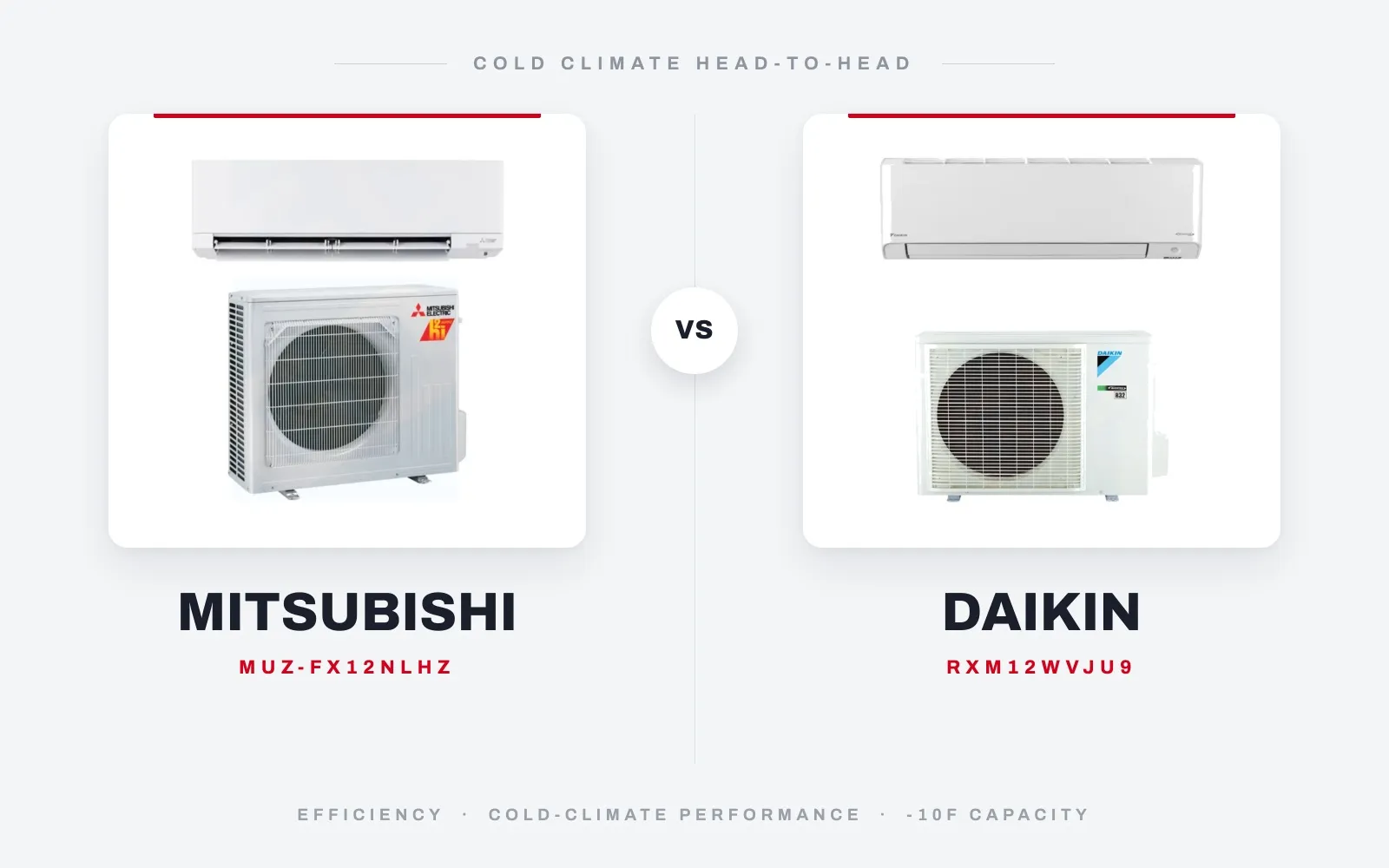
Earlier in this series we compared the value lines, and we told you the truth: none of them is a cold climate machine, and none should be the only heat source in a room without backup. This post is what happens when you move up to the equipment that is built for exactly that job. In the Mitsubishi H2i vs. Daikin Atmosphera matchup, you have both brands' flagship cold climate wall units: the Mitsubishi MSZ-FX12NL paired with the MUZ-FX12NLHZ hyper-heating outdoor unit, against the Daikin FTXM12WVJU9 with the RXM12WVJU9. We pulled the official submittal sheets for both, and this time the verdict is not close.
The quick verdict
The Mitsubishi FX wins this one decisively. It posts higher efficiency on all three headline ratings, a larger maximum heating output, and the claim that defines the category: 100% of its rated heating capacity at 10 degrees below zero, with guaranteed operation down to 22 below. The Daikin Atmosphera is a genuinely strong machine that earns real points, including a slightly higher rated heating figure and a 12-year warranty that needs nothing more than registration. But at the tier where winter performance is the whole point, the submittal sheets put the Mitsubishi clearly ahead.
The spec table, submittal vs. submittal
SEER2: Mitsubishi 29.9; Daikin 25.2
EER2: Mitsubishi 15.4; Daikin 13.2
HSPF2: Mitsubishi 12.4; Daikin 10.7
Rated cooling: Mitsubishi 12,000 BTU (max 16,100); Daikin 12,000 BTU (max 16,000)
Rated heating at 47F: Mitsubishi 13,200 BTU; Daikin 13,600 BTU
Max heating at 47F: Mitsubishi 23,500 BTU; Daikin 22,600 BTU
Full capacity held to: Mitsubishi -10F; Daikin 5F (per Daikin's published claim)
Operating floor: Mitsubishi Guaranteed to -22F; Daikin Published range to -13F
COP at 47F: Mitsubishi 4.2; Daikin 4.4
Refrigerant: Mitsubishi R-454B; Daikin R-32
Parts warranty: Mitsubishi 12 yr via Diamond contractor; Daikin 12 yr registered
Every Mitsubishi figure comes from the official Mitsubishi Electric submittal, and every Daikin figure from Daikin's official submittal data, with the two Daikin cold-weather claims attributed to Daikin's published materials. Now the parts worth understanding.
Efficiency: a sweep, not a squeaker
In the value-line comparisons, efficiency wins came down to decimals. Not here. The FX posts 29.9 SEER2 against the Atmosphera's 25.2, a 15.4 EER2 against 13.2, and a 12.4 HSPF2 against 10.7. That last number is the one a heat pump owner lives with, because HSPF2 measures heating season efficiency, and a cold climate unit in North Jersey spends far more hours heating than cooling. With electricity on a PSE&G or JCP&L bill running well above the national average, a gap that size compounds every winter for the life of the system.
The honest counterpoint from the Daikin side: its rated heating at 47 degrees is slightly higher, 13,600 against 13,200, and its COP at that same test point edges the Mitsubishi at 4.4 against 4.2. On a mild December afternoon, the Atmosphera is marginally the stronger and thriftier machine at its rating point. The Mitsubishi's answer is everything that happens below that temperature.
The cold weather story: what 100% at minus 10 actually means
This is the number that decides the category, so let's be precise about what it says. The Mitsubishi submittal rates the FX at 13,200 BTU of heating at 47 degrees. At minus 10 degrees, the same submittal lists a maximum output of 13,200 BTU. That is not a rounding coincidence. It is the meaning of H2i sumo hyper-heating: the full rated capacity of the machine, delivered at 10 below zero, with guaranteed operation continuing to minus 22.
The published curve in between tells the story: up to 18,200 BTU available at 17 degrees, 16,200 at 5 degrees, 14,500 at 5 below, 13,200 at 10 below, and still 8,700 at minus 22. On the coldest morning North Jersey has recorded in decades, this unit would still be producing meaningful heat.
Daikin publishes a strong claim of its own, 100% heating capacity at 5 degrees, with an operating range extending to minus 13. Those are genuinely good cold climate numbers, better than anything in the value tier. The difference is 15 degrees of headroom: where the Atmosphera's published range ends, the Mitsubishi is still holding full capacity. For a system you are trusting as primary heat in January, that margin is the product.
Warranty: same years, different paths
Both units carry 12-year parts coverage, and the difference is how you get it. Daikin grants 12 years on parts with simple online registration, which is the most accessible top-tier warranty in this comparison and a fair point in its favor. Mitsubishi's 12-year parts and compressor coverage requires installation in a single-family home by a Diamond contractor with registration inside 90 days. Air Temp is a Mitsubishi Diamond Elite contractor and we handle that registration, so through our shop the paths converge: full 12-year coverage either way, with the Mitsubishi adding compressor coverage under the Diamond terms and a deep North Jersey service network behind it.
Price, rebates, and the right time to do this
Cold climate flagships are quoted for the exact installation, because the equipment tier, the electrical scope, and the mounting details all move the number. What we promise is the same thing we promise on every job: an upfront installed price in writing before you sign, with no change orders on install day.
The rebate picture is where this tier gets interesting. New Jersey's richest heat pump incentives are aimed at exactly this class of equipment: the Whole Home Energy Solutions Program pays from $2,000 up to $7,500 based on whole-project energy savings, and the utility programs reserve their top equipment tiers for high-efficiency cold climate models. The FX is ENERGY STAR certified per its submittal, and we verify the exact rebate eligibility for your model and your home as part of the quote, then handle the paperwork.
And the timing: if you are considering a heat pump as primary heat for this winter, late summer and early fall is the window. Installer schedules are open before the heating rush, and the system is running before the first cold snap instead of being installed during one.
Frequently Asked Questions
Is Mitsubishi H2i better than the Daikin Atmosphera?
At the 12,000 BTU cold climate tier, the official submittal data favors the Mitsubishi FX clearly. It leads on all three efficiency ratings at 29.9 SEER2, 15.4 EER2, and 12.4 HSPF2 against the Atmosphera's 25.2, 13.2, and 10.7, holds 100% of rated heating at minus 10 degrees with guaranteed operation to minus 22, and offers a higher maximum heating output. The Atmosphera answers with a slightly higher rated heating figure, a better COP at 47 degrees, and a 12-year warranty by simple registration.
How much heat does the Mitsubishi FX deliver in cold weather?
Per the official submittal, the MUZ-FX12NLHZ delivers up to 18,200 BTU at 17 degrees, 16,200 at 5 degrees, 14,500 at 5 below zero, its full rated 13,200 at 10 below, and 8,700 even at minus 22. The defining spec is that the maximum output at minus 10 equals the unit's rated capacity at 47 degrees, which is what Mitsubishi's 100% capacity claim means. A built-in base pan heater keeps the outdoor unit clear during freezing weather.
Can a mini-split really be the primary heat source in New Jersey?
At this tier, yes, when it is sized correctly for the space. A cold climate unit that holds full capacity at minus 10 degrees covers the coldest weather North Jersey realistically sees, which is a different proposition from the value-line units we compared earlier in this series. The deciding factor is a proper load calculation: the system needs to be matched to the room's heat loss, not its square footage, and that is exactly what a site visit establishes before we quote.
Do cold climate mini-splits qualify for NJ rebates?
They are the class of equipment the top rebate tiers are designed for, which is a real advantage over value-line units. New Jersey's Whole Home Energy Solutions Program pays from $2,000 up to $7,500 based on whole-project energy savings, and utility programs like PSE&G and JCP&L reserve their richest heat pump rebates for high-efficiency cold climate models. Exact eligibility depends on each program's current qualified product list, so we confirm what your specific system and home qualify for as part of every quote.
Get the Winter-Ready Answer for Your Home
The value lines are fine cooling companions. This tier is a heating decision, and the submittal sheets say the Mitsubishi FX is the stronger machine for a North Jersey winter, with the Daikin keeping enough real points that the choice deserves a proper site visit rather than a coin flip. Either way, the right time to decide is before the cold arrives, not during it.
Air Temp Service Co has served North Jersey homeowners since 1999, family-owned by Mario and Lori Riccobono. Both NJ licenses are on file (HIC 13VH00127600 and Master HVACR 19HC00254600), and we hold Mitsubishi Diamond Elite and Trane Premier Contractor credentials. We install and service Mitsubishi hyper-heating systems across Passaic, Bergen, Essex, and Morris counties, with upfront pricing and rebate paperwork handled for you.
For a load calculation and an upfront quote on a cold climate system, call Air Temp at (973) 754-1232 or schedule online at airtempserviceco.com.