
You're holding a quote for a new HVAC system and half of it reads like a different language.
SEER2 rating: 17.5. AFUE: 96%. 3-ton condenser. R-410A. Manual J calculation included. MERV 13 filter compatible. The technician explained some of it, but the rest is just letters and numbers, and you're not entirely sure what you're paying for.
You're not alone. Most North Jersey homeowners don't deal with HVAC terminology more than once every 15 years, which is about how long a system lasts. The industry uses these terms every day. Homeowners hear them once and have to make a five-figure decision based on what they mean.
This glossary breaks down the terms that actually matter, grouped by what they tell you about a system. HVAC terms explained in plain English, from a North Jersey contractor who installs and services these systems every day.
The Basics
HVAC
Stands for Heating, Ventilation, and Air Conditioning. The umbrella term for any system that controls the temperature and air quality in your home. If you see "HVAC company" on a sign, that company handles both heating and cooling.
HVAC-R
Adds Refrigeration to the list. Companies marked HVAC-R also handle commercial refrigeration equipment, like walk-in coolers or supermarket cases. Most residential homeowners don't need to think about the R.
Ductwork
The network of metal or flexible tubes that carries conditioned air from your HVAC system to the rooms in your home, and pulls return air back to the system. North Jersey housing stock is older than most of the country, so a lot of homes have ductwork that was retrofitted decades after the home was built. That matters because the Department of Energy estimates 20 to 30 percent of conditioned air is lost through duct leaks in a typical home.
Manual J Load Calculation
The industry-standard math that tells a contractor what size system your home actually needs. A real Manual J accounts for square footage, insulation levels, window orientation, ceiling height, and air infiltration.
If a contractor quotes you a system size based on "your house is around 2,000 square feet," they're guessing. Sizing by rule of thumb leaves you with oversized equipment that short-cycles, runs inefficiently, and never pulls humidity out of the air.
Efficiency Ratings
This is where most of the confusing acronyms live. Each one measures how efficiently a different type of equipment turns energy into heating or cooling.
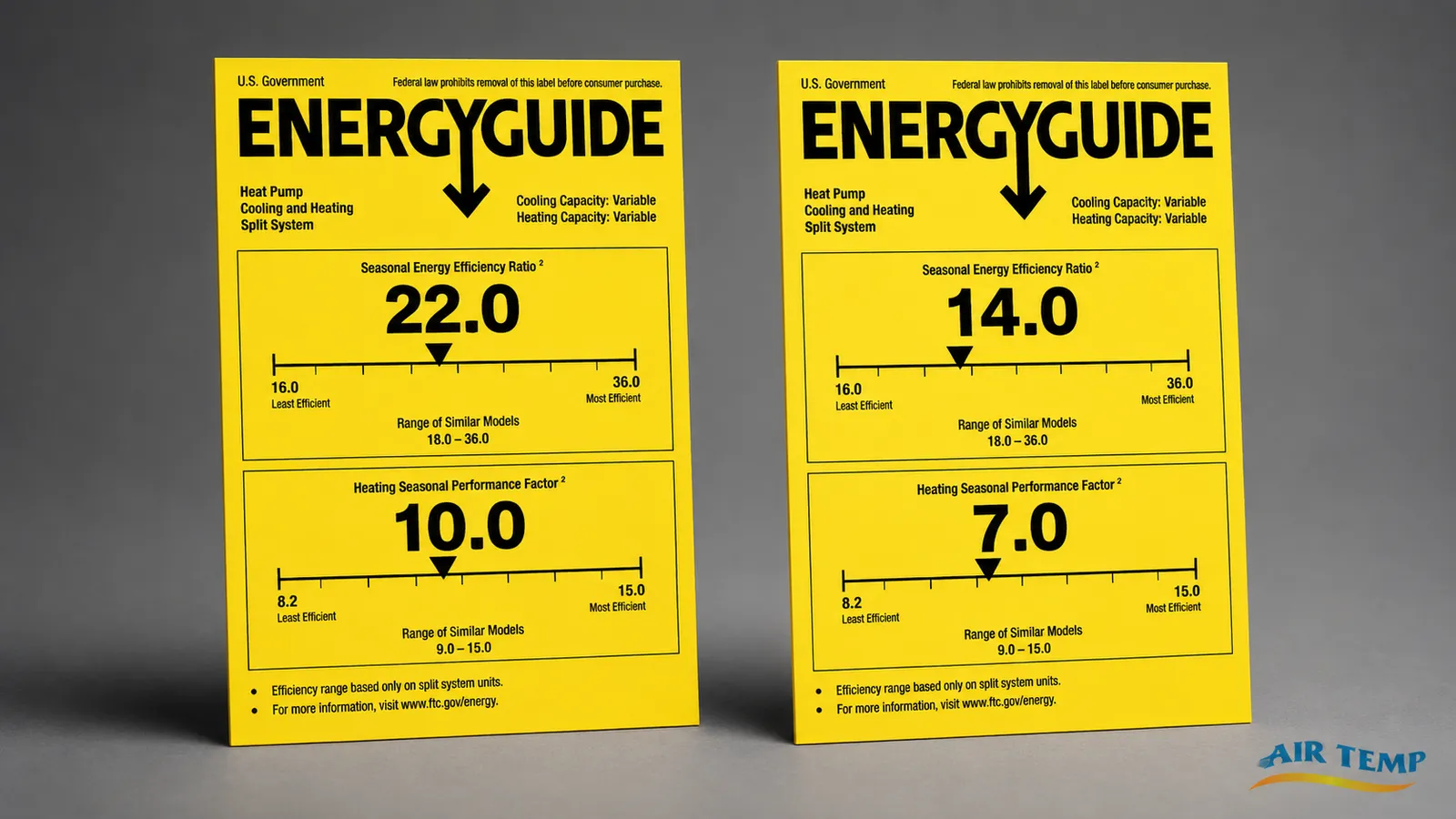
SEER and SEER2
SEER stands for Seasonal Energy Efficiency Ratio. It measures how efficiently an air conditioner or heat pump cools your home over an entire cooling season.
In January 2023, the Department of Energy replaced SEER with SEER2, which uses updated testing procedures that better reflect real-world conditions. If you're looking at a system manufactured after 2023, you'll see SEER2. If you're looking at an older system, you'll see SEER.
For North Jersey, which sits in the Northern climate region:
The current DOE minimum is 13.4 SEER2 for split-system air conditioners and 14.3 SEER2 for split-system heat pumps
A good mid-range system runs 15 to 17 SEER2
High-efficiency systems reach 18 to 22+ SEER2, with some Mitsubishi mini-splits hitting over 30
Higher SEER2 means lower cooling bills. The tradeoff is upfront cost. A 20 SEER2 system costs more than a 14 SEER2 system, but it can cut your cooling costs 30 to 40 percent year over year.
HSPF and HSPF2
HSPF stands for Heating Seasonal Performance Factor. It's essentially the heating-mode version of SEER, used specifically for heat pumps. Higher HSPF means a more efficient heating system.
Like SEER, HSPF was updated to HSPF2 in 2023 with stricter testing. Most quality heat pumps fall between 7.5 and 10 HSPF2, with top-tier cold-climate models exceeding that.
AFUE
AFUE stands for Annual Fuel Utilization Efficiency, and it applies specifically to gas furnaces and boilers. It's expressed as a percentage that tells you how much of the fuel you're paying for actually heats your home.
An 80% AFUE furnace converts 80% of the fuel into heat. The other 20% goes out the exhaust
A 90 to 95% AFUE furnace is considered high-efficiency
A 96 to 98% AFUE furnace is top-tier and qualifies for most utility rebates
The federal minimum for new gas furnaces is currently 80% AFUE. For North Jersey winters, where heating bills run high, a 95%+ AFUE furnace usually pays back the upfront premium within the system's lifetime.
COP
COP stands for Coefficient of Performance. It measures the ratio of heating or cooling output to electrical energy input.
A heat pump with a COP of 3.0 produces three units of heat for every one unit of electricity it uses. That sounds like cheating, but it's not. The heat pump isn't generating heat from electricity, it's moving heat from the outdoor air into your home, which takes far less energy than burning fuel or running an electric coil. That's why a properly sized heat pump can cut your heating costs significantly compared to electric resistance heating, which is locked at a COP of 1.0.
COP varies with outdoor temperature. Heat pumps perform best in mild weather. Cold Climate Heat Pumps (CCHP) are designed to maintain a useful COP down to single-digit outdoor temperatures, which matters in North Jersey winters where overnight lows can drop into the teens.
Capacity and Energy Units
BTU
BTU stands for British Thermal Unit. One BTU is roughly the energy it takes to raise the temperature of one pound of water by one degree Fahrenheit.
BTUs measure capacity. A larger BTU rating means more heating or cooling power. A typical residential AC system in North Jersey is rated somewhere between 24,000 and 60,000 BTUs, depending on the size of the home.
Bigger isn't always better. We see this all the time in Wayne and Hawthorne. A homeowner replaces a 2.5-ton AC with a 4-ton because they figure more power means better cooling. Six months later they're calling because the house feels cold and clammy, the system kicks on and off every five minutes, and the upstairs still won't cool. Oversizing is one of the most expensive mistakes in HVAC.
Tonnage
In HVAC, a ton isn't weight. It's a measure of cooling capacity equal to 12,000 BTUs per hour.
A 2-ton system produces 24,000 BTU/hr
A 3-ton system produces 36,000 BTU/hr
A 5-ton system produces 60,000 BTU/hr
Most North Jersey single-family homes run on a 2 to 4-ton system. A 1,800 square foot colonial in Caldwell with decent insulation typically needs 2.5 to 3 tons. A 3,500 square foot newer home in Wyckoff might need 4 to 5. Square footage alone won't tell you, which is why the Manual J calculation matters.
kW and kWh
kW stands for kilowatt, a measure of electrical power. kWh stands for kilowatt-hour, which is what shows up on your PSE&G or JCP&L bill. One kWh is the amount of energy a 1,000-watt appliance uses in one hour.
Heat pumps and air conditioners are typically rated by how many kWh they use over a season. Lower is better.
System Types
Central Air
A central AC system uses one outdoor condenser unit and one indoor air handler or furnace, distributing cooled air through ductwork to multiple rooms. Most North Jersey homes built since the 1970s have central air, often retrofitted into older homes.
Ducted Heat Pump
A heat pump that connects to your existing ductwork and replaces both your AC and your furnace, providing heating and cooling year-round. Lower upfront cost if you already have functional ducts. Heating efficiency depends on the model and outdoor temperature.
Ductless Mini-Split
A heat pump system that runs refrigerant lines from a small outdoor unit to wall-mounted indoor heads. No ductwork required. Each indoor head has its own thermostat, so you can heat or cool one room without conditioning the whole house.
Mini-splits are the go-to fix for the hot bedroom problem common in North Jersey colonials, the finished attic in a Montclair Victorian, or the addition off the back of a Wayne split-level that was never properly tied into the existing system.
As a Mitsubishi Diamond Elite Contractor, Air Temp installs ductless systems regularly for North Jersey homeowners who've given up on getting their upstairs to cool.
Cold Climate Heat Pump (CCHP)
A heat pump engineered to keep heating efficiently at low outdoor temperatures. Standard heat pumps lose efficiency below freezing. Cold climate models maintain useful heating output down to -13 to -15 degrees Fahrenheit depending on make and model.
North Jersey doesn't usually hit those extremes, but CCHPs are still worth the slight premium because they qualify for the higher tier of NJ Natural Gas rebates and they hold efficiency through the cold snaps that do happen.
Single-Stage, Two-Stage, and Variable-Speed
Three ways the compressor in an AC or heat pump can operate:
Single-stage: On or off, full blast or nothing. Cheapest, least efficient, leaves the air feeling clammy because it short-cycles
Two-stage: Runs at high or low speed. More efficient and more comfortable than single-stage
Variable-speed (inverter-driven): Runs at any speed between 30 and 100 percent of capacity. Most efficient, best at controlling humidity, quietest
For North Jersey's humid summers, variable-speed systems pull significantly more moisture out of the air than single-stage units. If your current AC cools the house down but you still feel sticky at 72 degrees, that's a single-stage system short-cycling and never running long enough to dehumidify. A variable-speed unit runs longer at lower speeds, which is what actually strips humidity. Mitsubishi, Trane, and Carrier all make strong variable-speed options.
Filters and Air Quality
MERV
MERV stands for Minimum Efficiency Reporting Value. It rates how well an air filter captures particles, on a scale from 1 to 20.
MERV 1 to 4: Captures large particles like lint and pet hair. Cheap fiberglass filters. The bare minimum
MERV 8 to 11: Standard residential range. Captures dust, pollen, mold spores
MERV 13 to 16: High-efficiency. Captures bacteria, smoke, fine particulates. Recommended for allergy sufferers
Most North Jersey homes do well with MERV 11 or MERV 13 filters. Going higher restricts airflow and can stress your blower motor unless the system is designed for it. If you have a family member with bad seasonal allergies (and North Jersey gets hammered with tree pollen in April and ragweed in September), MERV 13 is worth the small extra cost over MERV 11.
Refrigerants
R-410A, R-32, and R-454B
R-410A has been the standard refrigerant in residential AC and heat pump systems for the last two decades. It's currently being phased down under the federal AIM Act because of its high global warming potential.
Starting in 2025 and 2026, manufacturers transitioned to lower-GWP refrigerants:
R-32 is now common in Mitsubishi and other inverter-driven systems
R-454B is the new standard for Trane, Carrier, and Lennox central systems
Equipment already in your home isn't affected. If you're choosing a replacement now, you'll be on R-32 or R-454B.
You may still see R-22 in very old systems. It's been out of production for years and is prohibitively expensive when it leaks. If your system runs R-22, you're past replacement age.
Agencies and Programs
DOE
Department of Energy. Sets federal efficiency standards for HVAC equipment and other appliances.
EPA
Environmental Protection Agency. Regulates refrigerants and emissions related to HVAC. The agency behind the AIM Act phase-down of R-410A.
ENERGY STAR
A joint EPA and DOE program that certifies products meeting strict efficiency criteria. ENERGY STAR-rated HVAC equipment typically qualifies for utility rebates and federal incentives where available.
NJ Whole Home Energy Solutions Program
New Jersey's incentive program for whole-home energy upgrades. Offers rebates up to $7,500 based on total energy savings from a home assessment and qualifying improvements.
Local Utility Rebates
Air Temp's North Jersey service area is covered by these utility rebate programs in 2026:
PSE&G: $900 instant rebate on a qualifying heat pump
JCP&L: $500 to $1,000, depending on system tier
NJ Natural Gas: $500 to $1,000 for air source heat pumps, with the higher amount reserved for cold-climate models
Air Temp processes the rebate paperwork on the customer's behalf so the savings come off your project cost.
Frequently Asked Questions
What does SEER mean on an air conditioner?
SEER stands for Seasonal Energy Efficiency Ratio. It measures how much cooling an AC or heat pump produces compared to the electricity it uses over a typical cooling season. As of January 2023, the rating system updated to SEER2, with stricter testing that better reflects real-world performance. Higher SEER2 means lower cooling bills. The current DOE minimum for the Northern region (which includes North Jersey) is 13.4 SEER2 for split-system air conditioners.
What's a good SEER rating for North Jersey?
For most North Jersey homes, a SEER2 rating between 15 and 18 offers the best balance of upfront cost and long-term savings. Systems above 18 SEER2 cost more but pay back faster if you run your AC heavily through the summer or you're staying in the home long-term. Mini-splits and high-efficiency variable-speed central systems can reach 20+ SEER2.
What's the difference between BTU and ton in HVAC?
Both measure cooling capacity. One ton equals 12,000 BTUs per hour. So a 3-ton system has 36,000 BTU/hr of cooling capacity. HVAC quotes are usually written in tons for the system size and BTUs for the heating output of a furnace. The two units describe the same thing, just at different scales.
What does HSPF mean for heat pumps?
HSPF stands for Heating Seasonal Performance Factor. It's the heating equivalent of SEER, measuring how efficiently a heat pump produces heat over an entire heating season. As of 2023, the standard is HSPF2. Most quality heat pumps fall between 7.5 and 10 HSPF2, with top-tier cold-climate models exceeding that. Higher numbers mean lower heating bills.
Get a Quote You Can Actually Understand
Knowing the terms is half the battle. The other half is finding a contractor who walks you through what every line on the estimate actually means.
Air Temp Service Co has been doing this work in North Jersey since 1997, family-owned by Mario and Lori Riccobono. Both NJ licenses on file (HIC 13VH00127600 and Master HVACR 19HC00254600). Mitsubishi Diamond Elite Contractor and Trane Premier Contractor credentials, with a 5 to 10 year installation warranty stacked on top of 10 to 12 year manufacturer parts coverage.
If you want a free in-home estimate that includes a real Manual J load calculation and an itemized quote that explains every term it uses, call Air Temp at (973) 754-1232 or schedule online at airtempserviceco.com.