
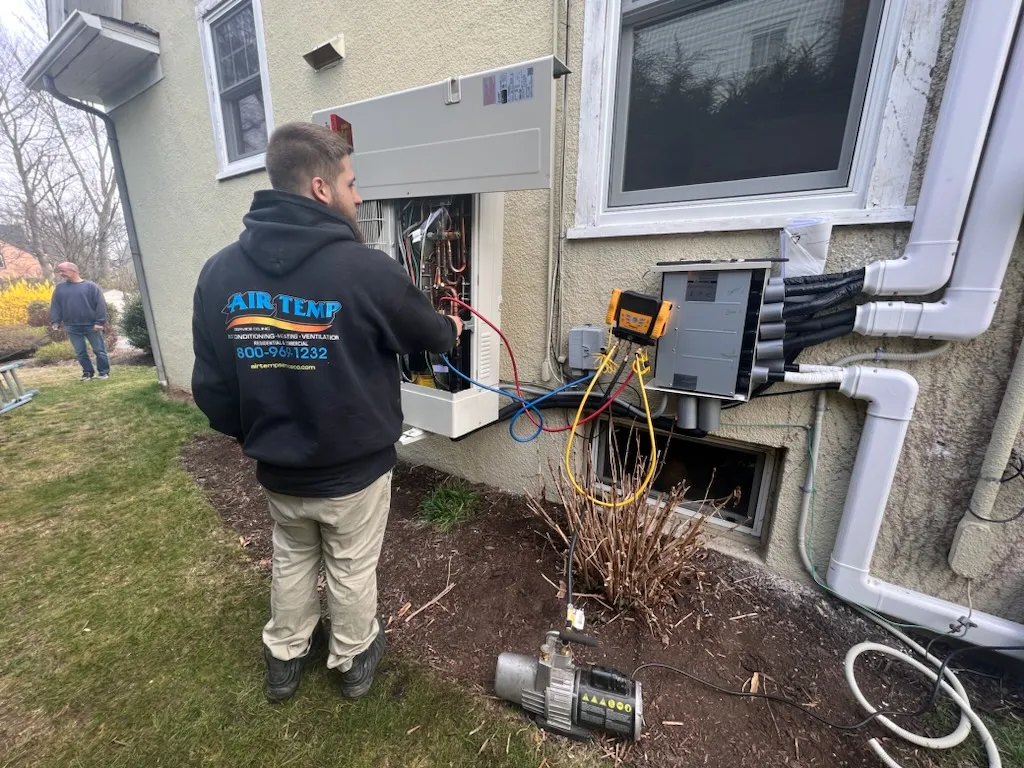
What to Expect During Heat Pump Installation: A North Jersey Homeowner's Guide
The install truck pulls into your driveway at 7:45 a.m. Three guys in navy uniforms unload tools, drop cloths, and a refrigerant manifold while you stand in the kitchen wondering what's about to happen to your house for the next eight hours.
You've signed the contract. The new heat pump is paid for. The rebate paperwork is processed. Now what?
Most North Jersey homeowners go through the heat pump installation process once or twice in their lives. The industry does it every day, but if it's your first time, you don't know what's a normal sound, what's a normal mess, what's a normal question to ask the crew, or how long any of it should actually take.
This guide walks you through every step, from the assessment visit to the final walkthrough, with realistic timelines and the surprises homeowners aren't always prepared for.
The Pre-Install Phase: Before the Truck Shows Up
Most of the work that determines whether your install goes well happens before installation day.
The In-Home Assessment
A real assessment takes 60 to 90 minutes. The contractor should be doing all of the following:
Measuring rooms and noting ceiling heights
Inspecting your existing ductwork for leaks, sizing issues, and condition
Looking at the electrical panel to confirm capacity for the new system
Identifying where the outdoor condenser will sit
Asking about hot spots, cold spots, and how you actually use your home
If a contractor shows up, glances at your existing equipment, and writes a quote in 15 minutes, that's not an assessment. It's a sales call wearing a clipboard.
The Manual J Load Calculation
This is the math that tells the contractor what size heat pump your home actually needs. A real Manual J accounts for:
Square footage
Insulation R-values
Window orientation and quantity
Ceiling height
Air infiltration rate
Square footage alone isn't enough. A 2,000 square foot Caldwell colonial with original 1950s insulation has very different needs than a 2,000 square foot newer build in Wyckoff. Sizing wrong is the most expensive mistake in HVAC, and it's a mistake the homeowner pays for over 15 years of inefficient operation. [Internal link: HVAC system sizing and consultation]
Permits and Rebate Paperwork
North Jersey towns require permits for HVAC equipment changeouts. Your contractor pulls these, schedules the inspection, and handles the paperwork.
The rebate paperwork is the other piece. North Jersey homeowners can stack multiple rebates on a heat pump install in 2026:
NJ Whole Home Energy Solutions Program: Up to $7,500, based on total energy savings
PSE&G: $900 instant rebate on a qualifying heat pump
JCP&L: $500 to $1,000, depending on system tier
NJ Natural Gas: $500 to $1,000 for air source heat pumps, with the higher amount reserved for cold-climate models
Air Temp processes the rebate paperwork on the customer's behalf so the savings come off your project cost.
Scheduling
Lead times in North Jersey vary by season [STAT NEEDED: confirm Air Temp's actual seasonal lead times before publishing]:
January to March: 2 to 4 weeks out
April to June: 4 to 8 weeks out (peak demand)
September to November: 2 to 4 weeks out
December: 1 to 3 weeks out for non-emergency work
If you can schedule for shoulder season (spring or fall), you'll get faster booking and more attentive crews who aren't running ragged through heat-wave emergencies.
What to Prep Before the Crew Arrives
A few things to handle the night before installation day:
Clear access to the indoor unit location (basement, attic, utility closet, or wherever the air handler is going)
Move furniture away from any walls the crew needs to access for line sets
Clear a path from the front door to the install area
Secure pets in a closed room or arrange to have them out of the house
Plan for noise. Drilling, sawing, and refrigerant handling are not quiet
Expect dust. Even with drop cloths, some dust is inevitable
Be available for questions. The crew may need decisions on small things like line set routing or thermostat placement
If you're getting a ductless mini-split, you'll also need to identify exactly where the indoor heads will go and where the line sets will run on the outside of the house.
Installation Day-by-Day: What Actually Happens
Heat pump installs in North Jersey typically run one to three days, depending on the system type and how much modification your home needs.
A Simple Replacement: One Day (4 to 8 hours)
If you're replacing an existing AC or heat pump and reusing functional ductwork, the install wraps in a single workday. Here's how it breaks down.
Morning: Removal and Prep (2 to 3 hours)
The crew arrives between 7 and 9 a.m. After a quick walkthrough, they:
Lay drop cloths through the house from the entry to the work area
Cut power at the breaker and disconnect the old system
Capture the refrigerant from the old unit (EPA-regulated, handled by licensed techs only)
Remove the old outdoor condenser and indoor air handler
Haul the old equipment out
If your old system used R-22 or R-410A, that refrigerant has to be properly recovered. This isn't a step you can skip.
Midday: New Equipment Install (2 to 3 hours)
New outdoor condenser positioned on its pad (concrete pad, composite pad, or wall mount)
New indoor air handler installed and connected to existing ductwork
Refrigerant line set run between indoor and outdoor units
Electrical disconnect and wiring connected to the panel
New thermostat installed if part of the contract
Afternoon: Commissioning and Testing (1 to 2 hours)
This is the part homeowners often don't see but matters most. The crew:
Pulls a deep vacuum on the refrigerant lines to remove all air and moisture
Performs a pressure decay test to verify there are no leaks
Charges the system with refrigerant to manufacturer specifications
Verifies operation in both heating and cooling modes
Walks you through the thermostat, the maintenance schedule, and the warranty paperwork
A proper commissioning takes time. If the crew is in a hurry to leave, ask whether they've completed the pressure decay test and the full charge verification.
A Ducted Install With Modifications: Two Days
If your existing ductwork needs sealing, modifications, or partial replacement, the install runs two days.
Day one focuses on equipment removal, ductwork modifications, and rough-in of the new system.
Day two completes the line set, electrical work, and full commissioning.
This is common in older North Jersey homes, like the colonials in Hawthorne or the splits in Wayne, where retrofitted ductwork from a 1980s AC installation isn't sized correctly for modern variable-speed equipment.
A Ductless Mini-Split Install: One to Two Days
Mini-splits don't need ductwork, which is what makes them perfect for the hot bedroom problem in older Little Falls capes or the finished attic suite in a Montclair Victorian. But each indoor head requires:
A hole drilled through the exterior wall for the line set
A line set run from the indoor head to the outdoor unit (often along the outside of the house, hidden in a line cover)
Electrical and condensate connections at the indoor head
A single-zone mini-split wraps in one day. A multi-zone install with three or four indoor heads typically runs two days.
As a Mitsubishi Diamond Elite Contractor, Air Temp installs ductless systems regularly across Passaic, Bergen, Essex, and Morris counties. [Internal link: ductless mini-split installation]
A New Ductwork Install: Three Days
If your home doesn't have existing ductwork (some older Bergen County homes in Ridgewood, Hillsdale, or Oradell that were built for boiler-radiator heat), or if the existing ducts are unsalvageable, you're looking at a three-day install minimum.
Day one is demolition and rough-in. Day two is duct fabrication and installation. Day three is equipment install and commissioning.
After the Install: What to Expect in the First Week
The crew leaves around 4 or 5 p.m. on the final day. Here's what to watch for.
The First 24 Hours
Your new system should hold the set temperature consistently. If it doesn't, or if you hear unusual noises, call the installer. Most reputable contractors include 24-hour follow-up coverage on the first night.
The First Week
Run the system in both heating and cooling modes if the weather allows
Listen for short-cycling (rapid on-off cycles)
Check that all rooms are reaching the set temperature
Note any odd smells (a faint "new equipment" smell is normal for the first few hours)
The Town Inspection
A municipal inspector will schedule a visit to verify the install meets code. Your contractor coordinates this. You don't have to do anything except be home for the inspection window.
Warranty Activation
Your installer should handle the manufacturer warranty registration. For Mitsubishi systems installed by a Diamond Elite Contractor, the parts and compressor warranty extends to 12 years. Trane systems through a Premier Contractor are eligible for Trane's standard 10-year limited parts warranty when the equipment is registered within 60 days of install.
Air Temp adds a 5 to 10 year installation warranty on top of the manufacturer's parts coverage.
A Quick Word on Refrigerants
If you're getting a new heat pump in 2026, it'll be on one of the new lower-GWP refrigerants under the federal AIM Act phase-down. Most likely:
R-32 for Mitsubishi and most inverter-driven systems
R-454B for Trane, Carrier, Lennox, and most central systems
These replaced R-410A in residential equipment manufactured after January 1, 2025. They're slightly more efficient and have a lower environmental impact. Your existing R-22 or R-410A system isn't affected, but any new equipment will use the new refrigerant.
Cold Climate Heat Pumps: Worth the Premium in North Jersey?
North Jersey winters don't hit Minnesota extremes, but overnight lows in the teens and 20s are routine, and cold snaps into single digits happen most years.
Cold Climate Heat Pumps (CCHP) are engineered to maintain useful heating output down to -13 to -15 degrees Fahrenheit, depending on the make and model. Standard heat pumps lose efficiency below freezing and may need to lean on backup electric heat strips during cold snaps.
The premium for a CCHP is usually a few hundred dollars over a standard model. In return, you get:
Better efficiency in actual North Jersey winter conditions
The higher tier of NJ Natural Gas rebates ($1,000 vs. $500)
More usable heat without dipping into resistance heat backup
For most North Jersey homeowners, the CCHP premium pays back within a few seasons. [Internal link: heat pump installation NJ]
Frequently Asked Questions
How long does heat pump installation take?
A standard replacement install in North Jersey takes one day, typically 4 to 8 hours, when you're replacing existing equipment and reusing functional ductwork. More complex jobs run longer. A multi-zone ductless mini-split or an install with ductwork modifications usually takes two days. A full new ductwork install with a heat pump runs three days. The total project timeline, including the in-home assessment a week or two before installation and the final town inspection a few weeks after, spans roughly four to six weeks from contract to closeout.
What permits do I need for a heat pump in NJ?
New Jersey towns require permits for HVAC equipment changeouts. Your licensed contractor pulls the permit and schedules the inspection. You shouldn't need to do anything except confirm a date for the inspector to visit. If a contractor offers a cash deal with "no need for permits," walk away. Skipping permits leaves you exposed when you sell the home and the buyer's inspector flags the unpermitted work.
Can a heat pump be installed in an old house?
Yes, and Air Temp installs them regularly in older North Jersey housing stock. The colonials in Caldwell, the capes in Little Falls, the Victorians in Montclair. The install approach depends on the home. If existing ductwork is functional, a ducted heat pump can replace your AC and furnace in a single day. If ductwork is undersized or unusable, a ductless mini-split system is often the better fit because it doesn't require duct modifications. Some homes do best with a hybrid setup, with a ductless head in a problem room and the main system handling the rest of the house.
How much does heat pump installation cost in NJ?
Residential heat pump installation in North Jersey typically runs $8,000 to $18,000 before rebates, depending on system type, size, and complexity. A simple ducted replacement using existing functional ductwork is at the lower end. A multi-zone ductless mini-split with three or four indoor heads runs higher. After stacking the NJ Whole Home Energy Solutions Program rebate ($7,500 max), PSE&G ($900), JCP&L ($500-$1,000), or NJ Natural Gas ($500-$1,000) rebates, most homeowners see total out-of-pocket cost reduced by several thousand dollars.
Get a Real Quote on Your Heat Pump Install
The heat pump installation process is straightforward when you know what to expect, and stressful when you don't. The contractor you pick determines whether installation day is a smooth eight hours or a three-week headache.
Air Temp Service Co has been installing heat pumps across Passaic, Bergen, Essex, and Morris counties since 1999, family-owned by Mario and Lori Riccobono. Mitsubishi Diamond Elite Contractor and Trane Premier Contractor credentials, with a 5 to 10 year installation warranty stacked on top of 10 to 12 year manufacturer parts coverage.
For a free in-home assessment that includes a Manual J load calculation, an itemized written quote, and full handling of your NJ rebate paperwork, call Air Temp at (973) 754-1232 or schedule online at airtempserviceco.com.