
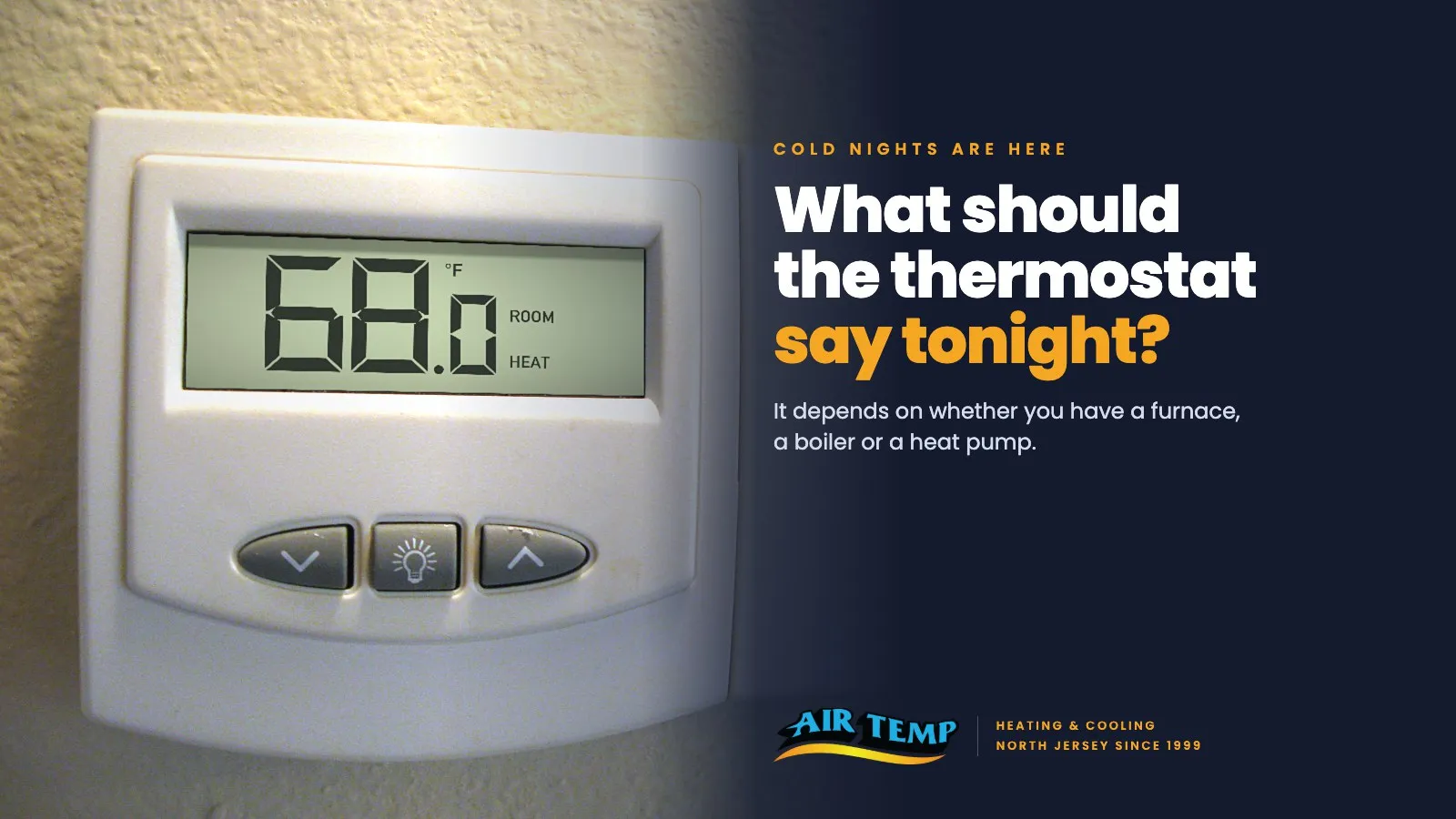
Every November in North Jersey, somebody bumps the thermostat up to 72. Then someone else turns it way down every night and announces that it's staying there until December. The best thermostat setting for winter is somewhere between those two people, and where exactly depends on how your house is heated.
Turning the heat down every night saves real money with a furnace, but with a heat pump the same habit can actually cost you. Boilers land somewhere in between.
Start at 68 to 70 while you're home and awake
For most homes, 68 to 70 degrees is about right while everyone's up and around. If you have a new baby or an older parent living with you, go a little warmer, and don't turn it down as far at night.
A big part of your heating bill comes down to the gap between the temperature inside and the temperature outside. Heat leaks out through the walls, windows and attic faster when that gap is big, and you pay to replace every bit of it.
If you have a furnace
With a gas or oil furnace, the usual advice is a setback: turn the thermostat down 7 to 10 degrees for about eight hours a day, while you sleep or nobody's home. Do the same in summer by setting the AC warmer while the house is empty, and over a full year you can cut as much as 10 percent off your heating and cooling bills. Homes in colder climates usually save a smaller share, so think of that as the best case.
Some people figure the furnace burns up whatever you saved overnight when it warms the house back up in the morning, but you still come out ahead. A cooler house leaks heat more slowly, so the longer it stays down, the more you save.
If nobody's home for four hours or more during the day, turn it down then too. A programmable or smart thermostat will handle all of this for you, and you can set it to start warming the house a little before your alarm goes off.
And don't crank it to 80 to warm up a cold house faster. With most furnaces, a higher number doesn't heat the house any quicker. It just keeps the furnace running until the house hits 80, and you pay for that extra heat.
If you have a boiler
Most boiler heat is slow to bounce back. A steam system or radiant floor heat can take several hours to bring a cold house back up to temperature, and cast-iron hot water radiators are slow too. So plenty of people with radiators figure turning the heat down isn't worth the trouble.
It can still save you money if you plan around the lag. Keep the overnight setback smaller than you would with a furnace, and have the heat come back on early. With steam, radiant floors or cast-iron radiators, that can mean two or three hours before you get up. Hot water baseboard warms up faster, so it needs less of a head start.
Some newer thermostats learn how long your system takes to warm the house back up and start the heat early on their own, so you don't have to guess at the timing. If you heat with a boiler, that's the kind to ask us about.
If you have a heat pump
In winter, a big setback can make a heat pump run less efficiently, and that can wipe out whatever you hoped to save. A steady, moderate setting is usually the cheapest way to run one.
On a ducted heat pump, the bigger risk is the morning. Many ducted systems have backup electric heat built in. Drop the setting 10 degrees overnight, ask for a big jump at 6 a.m., and the system may call on that backup heat to catch up. That backup heat costs far more to run than the heat pump itself.
If you still want a schedule, use a thermostat made for heat pumps. They're designed to keep backup heat to a minimum.
If your heat pump is paired with a gas furnace, the backup is the furnace, not electric heat, and a modest setback is usually fine. Not sure which you have? Ask us and we'll tell you what makes sense.
With a ductless Mitsubishi system, we tell customers to pick a temperature they're comfortable with and leave it there. If you change it at night, keep it to a degree or two.
Before you buy a new thermostat
A smart thermostat can do the scheduling for you, but only if it suits your equipment. If your furnace or heat pump runs at more than one speed (two-stage or variable-speed), a store-bought smart thermostat may not run it right. And if you have a heat pump, a basic thermostat may not know how to handle its backup heat. Tell us the make and model of your furnace, boiler or heat pump before you buy, and we'll point you to one that fits.
Cold snaps and trips away
When a real deep freeze hits, skip the overnight setback, whatever kind of system you have. Keeping the house at the same temperature day and night costs a little more for a few days, and that's a lot cheaper than a frozen pipe.
Heading away for the holidays? Leave the heat on and never set it below 55 degrees. That goes for heat pump homes too. Turning it down once for a week away isn't the same as turning it up and down every night. When you get home, bring a ducted heat pump back up a couple of degrees at a time, so it's less likely to call on the backup heat. A smart thermostat lets you start that from your phone before you're back.
Where your thermostat sits matters
Even the right setting won't help if the thermostat is reading the wrong room. It should be on an inside wall, away from sunny windows, drafty doors and skylights. If yours sits next to a cold window or right above a heating vent, it'll turn the heat on and off at the wrong times. And don't park a bookcase in front of it. It needs air moving around it to get an accurate reading. If yours is in a bad spot, we can move it.
Frequently Asked Questions
What is the best thermostat setting for winter in New Jersey?
Around 68 to 70 degrees while you're home and awake works for most homes. With a furnace, turn it down 7 to 10 degrees while you sleep or are away. With a heat pump, keep a steady, moderate setting instead.
Does turning the heat down at night really save money?
With a furnace, yes. Turning it down 7 to 10 degrees for about eight hours a day pays off, and warming the house back up in the morning doesn't cancel that out. Do the same with the AC while you're out in summer and you can save up to 10 percent a year on heating and cooling, though homes in colder places tend to save a smaller share. Boiler homes can save too, as long as the heat comes back on early enough.
Should I turn my heat pump down at night?
Usually not, or only by a degree or two. A big setback can make a heat pump run less efficiently, and on ducted systems a big morning recovery can switch on expensive backup heat. A thermostat made for heat pumps can make a schedule work on a ducted system. If your heat pump is paired with a gas furnace, a modest setback is usually fine.
What temperature should I leave the heat at when I go away?
No lower than 55 degrees. That helps protect the pipes and still cuts your heating bill while nobody's home.
So who wins the thermostat fight?
The best thermostat setting for winter starts at 68 to 70 degrees. Past that, it depends on what heats your house. In a furnace home, the person turning it down at night wins. Boiler homes can split the difference. In most heat pump homes, sorry, nobody wins. Pick one comfortable number and leave it alone. And if your system can't hold a steady temperature or leaves some rooms cold, a different setting won't fix it. That's when we should take a look.
Air Temp Service Co has served North Jersey homeowners since 1999, family-owned by Mario and Lori Riccobono. Both NJ licenses are on file (HIC 13VH00127600 and Master HVACR 19HC00254600), and we hold Mitsubishi Diamond Elite and Trane Premier Contractor credentials. We service heating systems across Passaic, Bergen, Essex, and Morris counties, with upfront pricing and rebate paperwork handled for you.
Call (973) 754-1232 to book a heating check, and ask us which thermostat makes sense for the system you have.