
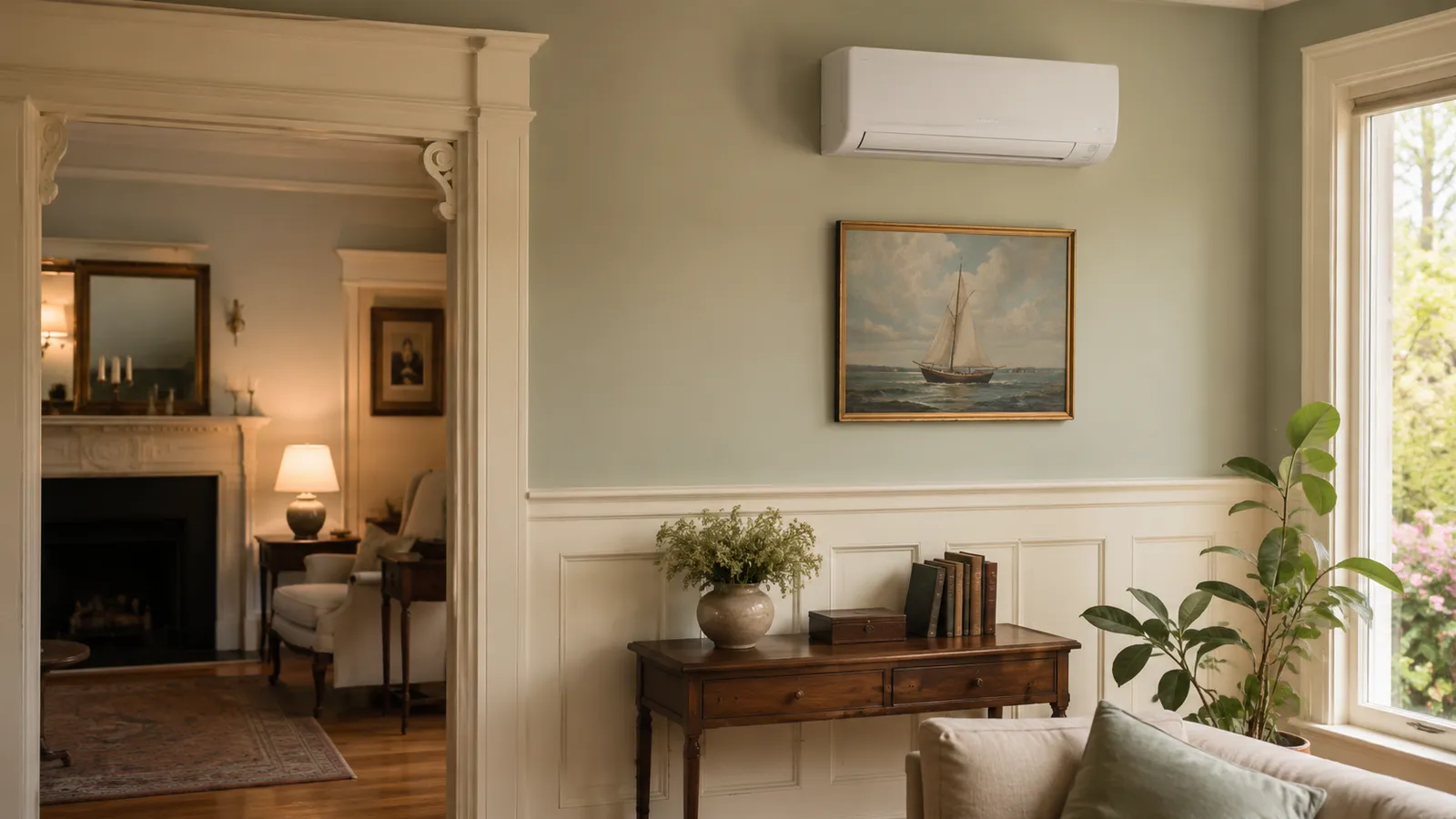
Your house was built in 1925, and it has radiators in every room and not a single air duct anywhere. For years the answer to summer was a couple of window units wedged into the front rooms and a box fan on the stairs. Then July hits, the second floor turns into an oven, and you start wondering what it would actually take to add AC to an older home without ductwork. Good news: you have more options than you think, and most of them do not involve tearing your plaster walls apart.
North Jersey is full of these homes. The Victorians in Montclair, the colonials in Caldwell, the capes in Little Falls, all built decades before central air was standard. Here is how cooling one actually works, what each path costs, and how to pick the right one for your house.
Why older North Jersey homes skip the ducts in the first place
Most homes built before the 1960s were heated by a boiler pushing hot water or steam to radiators. There was never any ductwork because the heating system never needed it. That is great for cozy winter heat and a real problem when you want central cooling, because traditional central AC depends on a network of ducts to move air through the house.
Retrofitting full-size ducts into a finished older home is invasive. It usually means opening walls and ceilings, boxing in soffits, and giving up closet space for chases. In a home with plaster walls or tight framing, that can turn into a renovation you did not sign up for. The whole reason the options below exist is to get you cooling without that demolition.
Option 1: A ductless mini-split
For most older North Jersey homes, a ductless mini-split is the simplest answer. It pairs an outdoor condenser with one or more slim indoor units mounted high on the wall, connected by refrigerant lines that run through a 3-inch hole instead of a duct chase. Each indoor head cools the room or zone it serves, and you control each one independently.
Because there are no ducts, you skip the demolition entirely. A single-zone system handles one problem room, like a hot upstairs bedroom or a finished attic over the garage. A multi-zone system runs three or four indoor heads off one outdoor unit to cool the whole house. As a Mitsubishi Diamond Elite Contractor, Air Temp installs these across Passaic, Bergen, Essex, and Morris counties, and they are a strong fit for the Montclair Victorian or the Caldwell colonial that never had a duct in its life. [Internal link: ductless mini-split installation]
What it costs
A ductless single-zone system runs $5,000 to $7,000 in North Jersey. A two-zone system runs $7,000 to $11,000, and a multi-zone setup with three or four heads runs $12,000 to $20,000. The wide range reflects how many rooms you are cooling and how much line-set routing your home needs.
Option 2: A high-velocity small-duct system
If the look of a wall-mounted head is a dealbreaker, a high-velocity system is the other no-demolition path. Instead of large rectangular ducts, it uses flexible tubing only about 2 inches across that snakes through existing wall cavities, floor joists, and closets. The air comes out through small round outlets you can tuck into ceilings and walls, so almost nothing shows.
High-velocity systems were designed for exactly this situation: older homes where standard ducts will not fit and homeowners who want central cooling without visible equipment. They cost more than a comparable mini-split because of the extra labor to route all that tubing, but for a period home where preserving the look matters, the tradeoff is often worth it.
Option 3: The hybrid approach
You do not have to cool the whole house the same way. A lot of North Jersey homeowners get the best result by mixing solutions. Maybe your first floor stays comfortable with a window unit or two, but the upstairs bedrooms are unbearable by 11 p.m. In that case, a single ductless head in the worst room solves the actual problem for a few thousand dollars instead of re-cooling the entire house.
This is also where a home with a basement or attic has an advantage. A contractor can sometimes place a compact air handler in the attic to feed the second floor through short duct runs, while a mini-split or the existing setup handles the first floor. The point is to match the fix to where the heat actually is, rather than forcing one system onto a house that was not built for it.
Why not just add full ducts and a central system?
It is a fair question, and sometimes the answer is yes. If you are already gutting the house for a major renovation, running proper ductwork while the walls are open can make sense. But as a standalone project in a finished older home, retrofitting full ducts plus a central AC is usually the most expensive and most disruptive route, and it can still leave you with the efficiency penalty that comes with ducts. The U.S. Department of Energy notes that duct losses can cut the air moving through a system by 20 to 30 percent through leaks and poor connections. Ductless and high-velocity systems sidestep a good chunk of that.
If you want a full breakdown of how ducted and ductless cooling stack up against each other, we cover that in detail elsewhere.
A few things every older home needs checked first
Whatever path you choose, an older North Jersey home has a couple of wrinkles a good contractor will check before quoting:
Electrical capacity. A home with a 1950s panel may need an electrical upgrade to support a new condenser. This gets confirmed during the in-home assessment.
Insulation and air sealing. Older homes often leak air. Sealing and insulating first means you can install a smaller, cheaper system that still keeps up.
Correct sizing. A Manual J load calculation sizes the system to your actual home, not a square-footage guess. Sizing wrong is the most expensive mistake in HVAC, and older homes vary too much to eyeball.
NJ rebates make the project easier to swallow
Because ductless mini-splits are heat pumps, they qualify for New Jersey's strongest cooling incentives. For 2026, the savings run through state and utility programs, since the federal 25C tax credit expired on December 31, 2025 and is not available for systems installed this year:
NJ Whole Home Energy Solutions Program: up to $7,500, based on your home's total energy savings.
PSE&G: a $900 instant rebate on a qualifying heat pump or mini-split.
JCP&L: $500 to $1,000, depending on system tier.
NJ Natural Gas: $500 to $1,000 for air source heat pumps, with the higher amount for cold-climate models.
Air Temp processes the rebate paperwork on your behalf, so the savings come off your project cost instead of leaving you to chase forms.
Frequently Asked Questions
Can you put central air in a house without ductwork?
Yes. You have three main paths. A ductless mini-split uses slim indoor units and refrigerant lines through a 3-inch hole, with no ducts at all. A high-velocity small-duct system uses 2-inch flexible tubing that fits through existing wall cavities. Or you can retrofit full-size ducts and a conventional central system, though that is the most invasive and expensive route in a finished older home. For most North Jersey homes without ducts, a mini-split is the simplest and most cost-effective option.
How much does it cost to add AC to a house without ducts in NJ?
A ductless single-zone mini-split runs $5,000 to $7,000 in North Jersey, a two-zone system runs $7,000 to $11,000, and a multi-zone system with three or four heads runs $12,000 to $20,000. High-velocity systems typically cost more because of the extra labor to route the tubing. Final price depends on how many rooms you are cooling, your home's electrical capacity, and any sealing or insulation work. NJ rebates can take several thousand dollars off the total.
Is a ductless mini-split good for an old house?
It is one of the best fits there is. Older North Jersey homes like Montclair Victorians, Caldwell colonials, and Little Falls capes were built without ducts, and a mini-split adds cooling without tearing into plaster walls or sacrificing closet space. Each indoor head cools its own zone, so you can target the rooms that actually get hot, like a second floor or a finished attic, instead of re-cooling the whole house. It also doubles as efficient heating in the shoulder seasons.
Will adding AC damage my older home?
It should not, when it is done right. The whole reason ductless and high-velocity systems exist is to add cooling with minimal disruption. A mini-split needs only a small hole for the line set, and high-velocity tubing routes through existing cavities. The bigger risks in an older home are an undersized electrical panel or a system that was not sized correctly, which is why a proper in-home assessment with a Manual J calculation matters before any work starts.
Cool Your Older Home the Right Way
An older North Jersey home does not have to mean another summer of window units and box fans. Between ductless mini-splits, high-velocity systems, and smart hybrid setups, there is almost always a way to add real cooling without a gut renovation. The trick is matching the solution to your specific house, and that starts with someone who actually looks at it.
Air Temp Service Co has served North Jersey homeowners since 1999, family-owned by Mario and Lori Riccobono. Both NJ licenses are on file (HIC 13VH00127600 and Master HVACR 19HC00254600), and we hold Mitsubishi Diamond Elite and Trane Premier Contractor credentials. We work in older homes across Passaic, Bergen, Essex, and Morris counties every week, so we know how to add cooling without tearing your house apart.
For a free in-home assessment that includes a Manual J load calculation, an itemized written quote, and full handling of your NJ rebate paperwork, call Air Temp at (973) 754-1232 or schedule online at airtempserviceco.com.