
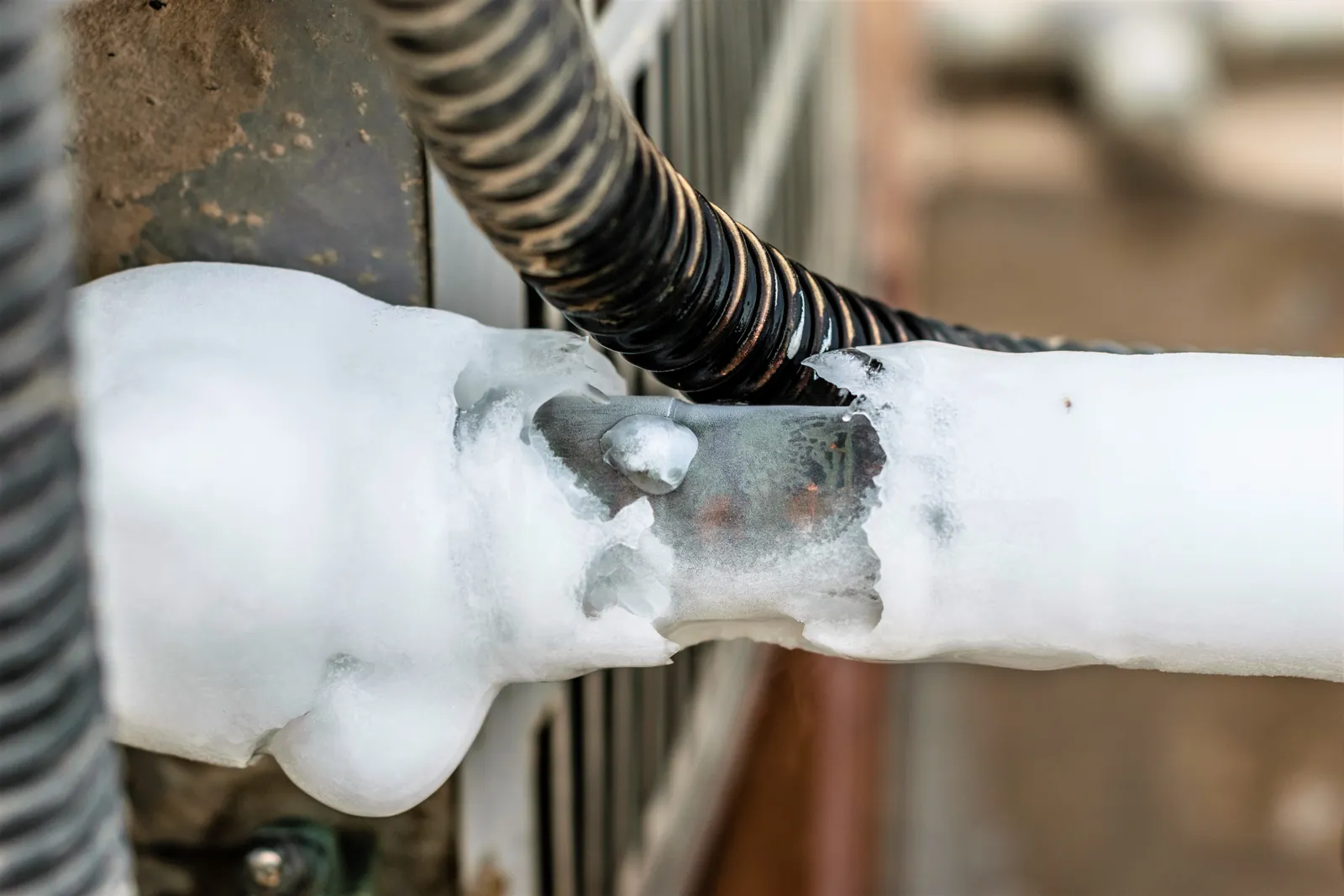
There is something deeply wrong about walking outside on a 92 degree North Jersey afternoon and finding your air conditioner wearing a coat of ice. The house is not cooling, the vents are blowing something closer to room temperature, and the refrigerant line running into your home is frosted over like a beer can. If you have ice on your AC line, your system is not working harder for you. It has effectively stopped working, and every minute you leave it running is a minute it can damage itself.
Here is what to do first, why it happened, and how to tell whether this is a filter problem or a phone-call problem.
First, turn it off
Before you read another word, go shut the system off at the thermostat, and switch the fan to ON.
That is not a typo. Turning the cooling off stops the system from making more ice. Leaving the fan running pushes warm indoor air across the frozen coil and helps it thaw faster. Most importantly, it stops liquid refrigerant from reaching the compressor, which is what happens when a coil is iced over and it is the reason a frozen AC turns into an expensive AC. The compressor is the single most costly component in your system, and it is designed to pump vapor, not liquid.
Do not chip at the ice, do not take a hairdryer to it, and do not attack the coil with anything sharp. The fins bend if you look at them wrong, and a punctured refrigerant line turns a repair into a replacement. Let it melt. Depending on how thick the ice is, expect one to three hours, sometimes longer. Put a towel down if the indoor unit is in a finished space, because all of that ice becomes water.
Why a coil freezes in the middle of summer
It seems backwards, but the physics are simple. Your evaporator coil gets cold, in the neighborhood of 40 degrees, and it pulls heat and moisture out of the air passing over it. That moisture condenses on the coil and drains away. The whole process depends on a steady stream of warm indoor air moving across that coil.
Take the warm air away, or make the coil colder than it should be, and the condensation stops draining and starts freezing. Once a thin layer of frost forms, it insulates the coil, which makes the coil colder, which makes more ice. It snowballs, literally.
Which means every cause of a frozen AC falls into one of two buckets.
Bucket one: something is blocking the airflow
This is the common one, and it is often something you can fix yourself.
A clogged air filter. The single most frequent cause. A filter thick with dust chokes off the air the coil needs. In a North Jersey summer with pollen and dust in the air, a filter can go from fine to filthy in a month.
Blocked or closed vents and returns. Furniture over a return, a rug across a floor vent, or a bunch of supply registers closed off in unused rooms all starve the system of air.
A dirty evaporator coil. Dirt on the coil itself acts as insulation and blocks airflow at the same time.
A failing blower motor. If the fan is not moving the volume of air the system expects, the result looks identical to a clogged filter.
Bucket two: the refrigerant charge is low
This one is not a fix, it is a diagnosis, and it means a leak.
Refrigerant does not get used up. It circulates in a sealed loop, so if the level is low, it escaped somewhere. Low refrigerant drops the pressure in the coil, the coil runs colder than designed, and it freezes even with perfect airflow. This is why a system that keeps freezing after you have changed the filter is telling you something specific: there is a leak, and someone needs to find it.
Topping off the refrigerant without repairing the leak is throwing money into the air, and in 2026 that is more money than it used to be.
Refrigerant is not a consumable. If your system is low, it is not thirsty. It is leaking.
What to do while it thaws
You have the system off and the fan running. Use the wait productively.
Pull the air filter. If you cannot see light through it, replace it. This alone solves a large share of frozen coils.
Walk the house and open every supply vent and clear anything sitting on a return.
Look at the outdoor unit and clear away grass clippings, leaves, and anything crowding it.
Note whether you saw ice on the indoor coil, the outdoor lines, or both, and tell the technician if you end up calling one.
Once the ice is fully gone, and it needs to be fully gone, switch cooling back on and watch it. If the air runs cold and stays cold, your problem was airflow and you fixed it. If it freezes again within a day or two, stop running it and call. A system that refreezes is not going to fix itself, and running it in that state is how a repair becomes a compressor replacement.
When to skip the DIY and just call
Some situations do not warrant an afternoon of troubleshooting.
Call a technician if the coil refreezes after a filter change, if you see oily residue near the refrigerant lines or the indoor unit, which is a classic sign of a leak, if you hear hissing or bubbling from the lines, or if the system has been freezing repeatedly over weeks. Also call if the ice is on the large copper line at the outdoor unit, since that pattern points more often at the refrigerant side than at your filter.
And if the house has been without cooling through a stretch of North Jersey heat with anyone vulnerable inside, do not spend two days experimenting. Get someone out.
Frequently Asked Questions
Why is there ice on my AC line?
Ice forms when the evaporator coil gets colder than it should and the moisture condensing on it freezes instead of draining. That happens for one of two reasons: airflow across the coil is restricted, usually by a clogged filter, blocked vents, a dirty coil, or a weak blower, or the refrigerant charge is low because of a leak, which drops the coil temperature below design. Once frost starts, it insulates the coil and the icing accelerates. Turn the system off, run the fan to thaw it, and check the filter first.
Can I run my AC if it is frozen?
No. Running a frozen system risks sending liquid refrigerant back to the compressor, which is designed to pump vapor, not liquid, and it is the most expensive part in your system to replace. A frozen coil also cannot cool your home, so you are paying for electricity and getting warm air. Shut the cooling off at the thermostat, set the fan to ON to speed the thaw, and let the ice melt completely before you restart it.
How long does it take a frozen AC to thaw?
Usually one to three hours with the cooling off and the blower running, though a heavily iced system can take considerably longer, occasionally most of a day. Running the fan moves warm indoor air across the coil and speeds it up. Do not try to speed it further with a hairdryer, a heat gun, or by chipping at the ice, since bent fins and punctured refrigerant lines turn a simple problem into an expensive one. Put down a towel, because the melt has to go somewhere.
Why does my AC keep freezing up after I changed the filter?
A system that refreezes after a fresh filter is usually pointing at a refrigerant leak. Refrigerant circulates in a sealed loop and is never consumed, so a low charge means it escaped somewhere, and low charge makes the coil run colder than designed until it ices over. It can also be a dirty evaporator coil or a failing blower motor. All three need a technician, and continuing to run the system while it repeatedly freezes puts the compressor at risk.
Get the Ice Off and the Cold Back On
A frozen AC is one of those problems where the first move matters. Shut it down, let it thaw, and check the filter, because a real share of frozen coils are exactly that simple. But if it ices up again, the system is telling you there is something underneath it, and the cheapest version of that conversation is the one you have before the compressor is involved.
Air Temp Service Co has served North Jersey homeowners since 1997, family-owned by Mario and Lori Riccobono. Both NJ licenses are on file (HIC 13VH00127600 and Master HVACR 19HC00254600), and we hold Mitsubishi Diamond Elite and Trane Premier Contractor credentials. We cover Passaic, Bergen, Essex, and Morris counties, and we find the leak instead of just topping off the charge.
If your AC has iced up more than once, call Air Temp at (973) 754-1232 or schedule online at airtempserviceco.com.